
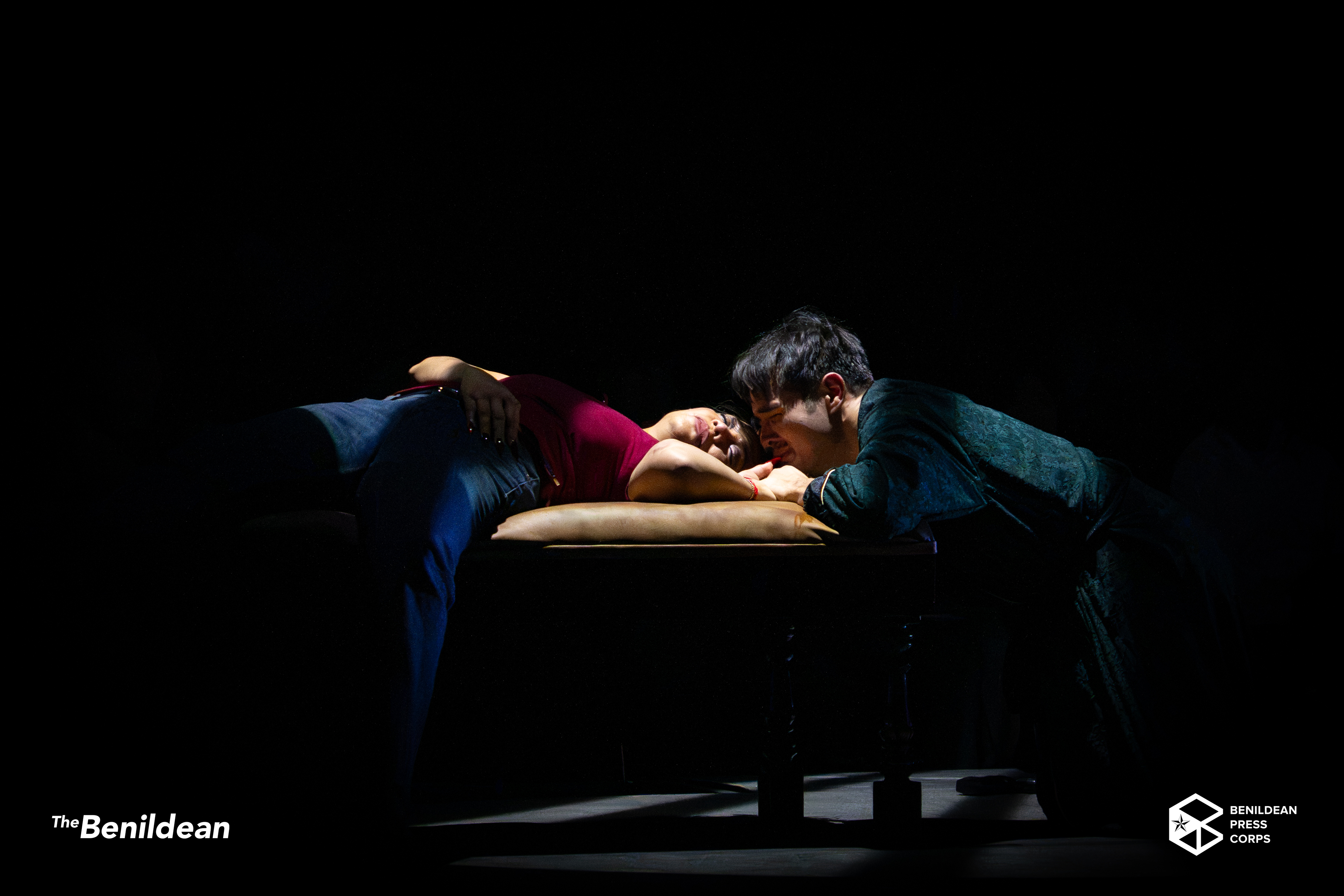




Centuries after Sophocles first brought his tragedy to the stage, “Oedipus Rex” finds new life in "REX,” a Filipino adaptation presented by De La Salle-College of Saint Benilde (DLS-CSB) through the School of Arts, Culture, and Performance (SACP), running from Nov. 12 to 22 at the Power Mac Center Spotlight Blackbox Theater, Circuit Makati.
Penned by Palanca Hall of Famer Joshua Lim So and directed by Armando Tuxqs Rutaqui, chair of the DLS-CSB Theater Arts program, the 45-minute production stars Eula Valdes and Martin del Rosario. It brings together students, faculty, alumni, and industry professionals in a collaborative undertaking involving several Benilde programs, including Theater Arts (ABTHA), Production Design (AB-PROD), Dance (BPAD), Music Production (ABMP), and Multimedia Arts (ABMMA).
These combined efforts take shape onstage through a fictional city, where a disaster exposes the fault lines within a powerful family.
A family in the eye of the storm
In the city of Tebes, a tropical depression brings torrential rains that cause the collapse of flood-control projects, leaving over a hundred people dead. At the center of the controversy is Eddie Po (Martin del Rosario), CEO of St. Paul the Apostle Constructions, the corporation behind the failed projects. Alongside him is his wife and business partner, Jacosta (Eula Valdes), whose own ties to the city run deeper than they initially appear.
As the city demands answers, those closest to the couple are drawn further into the unfolding crisis. Among them is Creon (Bong Cabrera), Jacosta’s brother, who also serves as their lawyer and business partner; Teresa (EJ Jallorina), a blind woman who arrives with knowledge of Eddie’s past; and Cora (Sheryll Ceasico), the family’s longtime housekeeper who has witnessed much of their private life.
Also caught in the affairs of Tebes is Jomar (Emilio Macabantad), an activist whose involvement offers another perspective to the city’s growing unrest. As old relationships and buried secrets come into play, the Po family discovers that some troubles cannot be settled with business deals.
A Greek tragedy is a Filipino’s reality
Sophocles’ “Oedipus Rex”—despite being centuries old—remains a compelling exploration of human nature in pursuit of truth. Its thematic inquiry of fate and the consequences of one’s actions transcends the period in which it was written. In "REX,” these familiar themes take on a distinctly Filipino identity.
While Sophocles’ tragedy unfolds in ancient Greece, "REX" finds its footing in a fictional Philippine city. The plague that once afflicted Thebes is reimagined as a tropical depression that triggers the collapse of flood-control projects, bringing the city to its knees. This change in setting places the tragedy within a reality all too familiar to Filipino audiences.
The decision to ground the play in a local context is timely given the Philippines' own ongoing flood control controversy. Billions of pesos have been allocated for flood mitigation, yet multiple investigations have raised concerns over projects that were reportedly nonexistent or poorly executed. For communities that continue to experience flooding, these revelations highlight the disparity between the money spent on protection and the safety they were promised.
Realities behind the reinterpretation
The similarities between "REX" and real-life figures were not lost on the cast. During the post-show talkback, Valdes and del Rosario were asked whom they drew inspiration from when portraying their respective characters. Both gave the same answer: "Discaya,” referring to contractor couple Sarah and Curlee Discaya, whose involvement in the flood-control controversy has made them familiar figures in the national conversation.
Meanwhile, during the same talkback, So mentioned that he eventually had to step back from his initial approach to the characters, which was heavily influenced by his frustrations with real-world frustrations.
“Wait, I’m writing from hate. I cannot write,” he admitted, recognizing that his anger was keeping him from developing the characters beyond their faults. He then revisited the script and reworked the characters, connecting the roles better to give the characters’ relationships greater weight within the narrative.
This effort to bring a classical tragedy closer to the present also shaped the production's direction. Rutaquio shared that staging Oedipus "REX" had long been one of his ambitions, particularly because of what it taught him about the truth. For “REX,” however, he wanted to “contemporarize” the classical work, finding renewed relevance in its themes amid the political realities unfolding in the Philippines.
The centuries separating “REX” from its Greek inspiration have done little to diminish the questions that first made Sophocles' tragedy compelling. Through its contemporary Filipino setting, the production presents how stories can be reinterpreted across generations while preserving the conflicts that make them worth telling.
When the curtain falls, the fictional city of Tebes is left behind. The realities that inspired it, however, remain outside the theater doors.
Discover how an age-old tragedy finds new meaning in the Filipino experience through “REX,” running from Nov. 12 to 22 at the Power Mac Center Spotlight Blackbox Theater. Tickets are available via Ticket2Me, with seating options ranging from floor-level views to elevated bleachers.
