
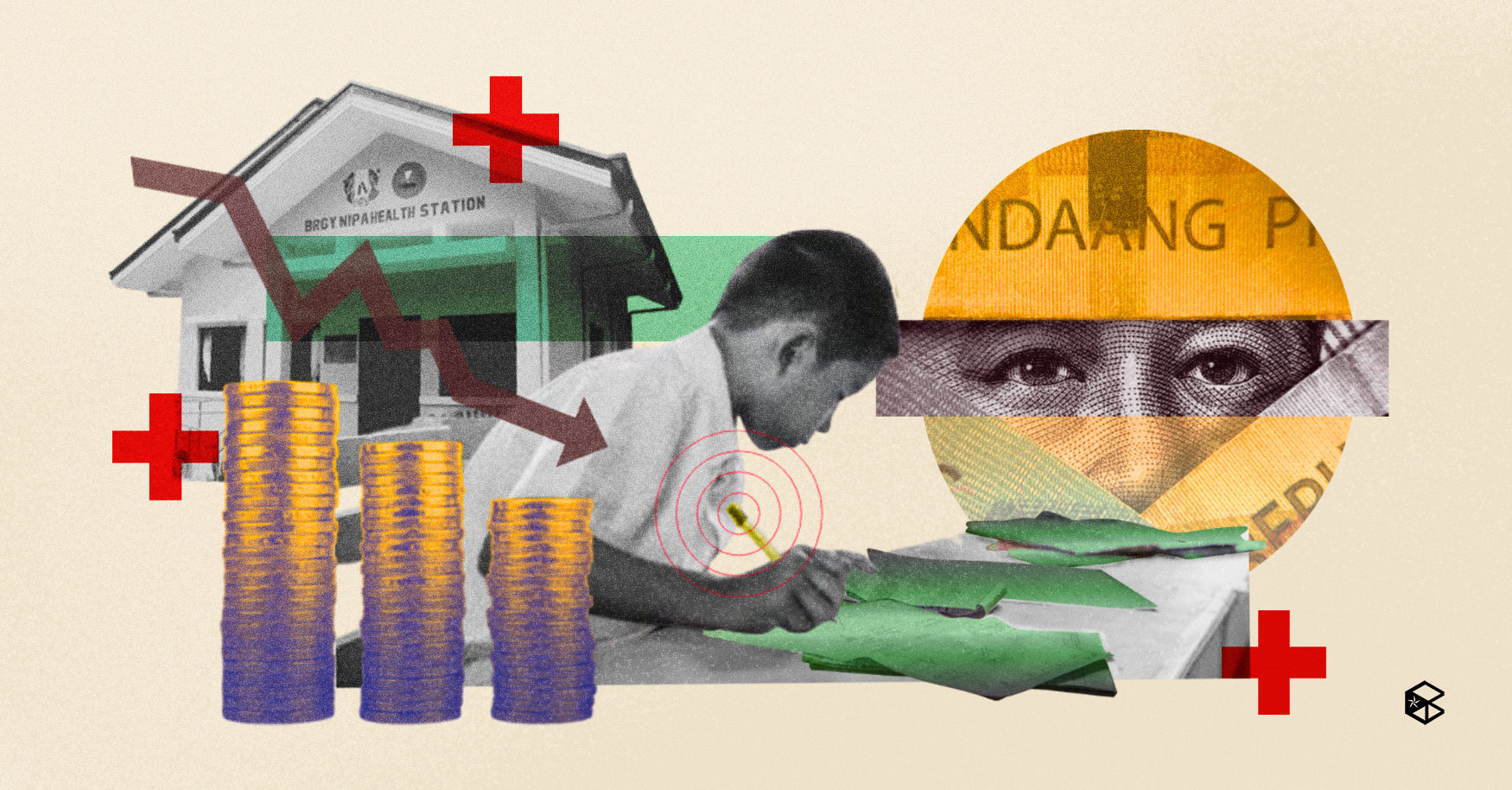




The House of Representatives approved the ₱7.2 trillion National Expenditure Program (NEP) for Fiscal Year 2027 on Oct. 12 during its third and final reading. The proposed budget prioritizes major financial investments in social services, infrastructure, and food security.
Determining national annual funds
The national budget, consisting of government funds sourced from citizens’ taxes and public borrowings, funds the government’s programs, activities, projects (PAP), and resources for national development and social amenities disseminated among government departments. Local government units (LGUs), government-owned and/or controlled corporations (GOCCs), and the country’s debt repayments are managed through the Budget Cycle, a continuous annual process of planning and sourcing the funds within a fiscal year.
The budget process begins with budget proposals from government agencies to the Department of Budget and Management (DBM) and the Development Budget Coordination Committee (DBCC) to form the NEP. Congress then reviews the NEP to draft the General Appropriations Bill (GAB), which the President will sign into law as the General Appropriations Act (GAA). Finally, agencies spend the approved funds under the Allotment Release Program (ARP) and submit reports to the DBM, DBCC, and the Commission on Audit (COA) for evaluation and accountability.
For 2027, social services will receive the largest allocation at ₱2.46 trillion, covering education, health, and social welfare. Economic services follow with ₱1.83 trillion, covering agriculture, infrastructure, transport, energy and water resources, and trade. General public services receive ₱1.32 trillion, followed by debt servicing at ₱1.14 trillion, and defense at ₱4.52 billion.
“Our national budget serves as our moral and economic compass. It must always point toward making life better for our people. This reflects our unwavering commitment to building a resilient, inclusive, and prosperous nation […] It is a strategic investment in the Filipino people and in our country’s future,” President Ferdinand “Bongbong” R. Marcos Jr. said in his Budget Message.
Despite these priorities, concerns persist over whether allocated funds will effectively serve the needs of taxpayers and ordinary citizens, raising questions about how public funds are distributed and utilized.
During an Oct. 26 Senate hearing, several national budget watchdogs from civil society organizations pointed out anomalies in the proposed budget bill by the House of Representatives. They identified approximately ₱1 trillion in questionable allocations in next year’s spending plan.
Mr. Adolfo Jose Montesa, co-convenor of the People’s Budget Coalition (PBC), presented records identifying ₱210 billion in ‘soft pork’, in the form of patronage-driven aid, ₱695 billion in ‘hard pork’, or politicized infrastructure, and ₱112 billion in ‘shadow pork’, referring to unprogrammed appropriations. The budget insertions are described as “budget that serves politicians before it serves the people.”
“We call for Congress to assess these allocations against unmet needs in health, education, livelihood, disaster resilience, and social protection. And explain how the proposed spending addresses these priorities despite the already many budget lines addressing these needs.” Catherine Basallote, speaker for the Caucus of Development NGO Networks, said expressing concerns over the proposed allocations.
The House also inserted 7,000 projects worth ₱190 billion without available attachments. PBC co-convenor Kenneth Abante reported that some coordinates for proposed farm-to-market road projects pointed to locations in Benham Rise and the Celebes Sea, while certain building projects were traced to Algeria and Nigeria.
House Leaders assured that amendments to the budget bill would be validated should errors be identified. These discrepancies have intensified calls for transparency and accountability in public expenditures, particularly as the ongoing El Niño is expected to persist through the first half of 2027.
In an interview with Karen Davila, economist JC Punongbayan said that the required staff work was lacking, and details are incomplete and sometimes incorrect. He stressed that budget insertions should be evidence-driven and responsive to the public needs, and that even typographical errors could have significant consequences.
Several foreign-assisted projects also faced cuts. The DPWH’s Laguna Lakeshore Road Network Phase I saw a cut of approximately 77%, followed by the DOTr's Metro Manila Subway Phase I with almost ₱20 billion. The North-South Commuter Railway also experienced a ₱15 billion decrease.
Many of these projects have commitment fees under pre-signed loan agreements with multilateral and foreign agencies. Further delays could therefore increase financial penalties and prolong project completion.
The House also reduced funding for several projects in the proposed budget, including LGU disaster rehabilitation and reconstruction, health, immunization, and nutrition. Lawmakers slashed the Health Facilities Enhancement Program by ₱4 billion and reduced the Department of Education’s school computerization budget by ₱3 billion.
“Any economist you would talk to would say that the biggest investment should go to human capital, which consists of education and health. Hindi lalago ang ekonomiya mo kapag hindi edukado nang maayos ang mga tao, as well as kung sila ay stunted, nagugutom, et cetera. So, you really need to invest.” Punongbayan said, emphasizing the importance of investing in education and health amid the proposed budget cuts.
While social services received the biggest allocation for next year’s budget, the cuts to vital health, education, and infrastructure are ironic, given its perceived prioritization. These cuts may be detrimental to the lives of Filipinos, especially to marginalized sectors of society.
Ongoing proceedings
As the House resumed sessions on Nov. 9, Makabayan bloc lawmakers filed House Resolution No. 1583, urging the chamber to recall the proposed 2027 budget to address concerns over flagged provisions.
However, on Nov. 10, the House also rejected a motion by Bagong Henerasyon Representative Robert Nazal to repeal and revise the 7.2 trillion budget. Nazal argued that provisions on unprogrammed appropriations violated the Supreme Court rulings from the 2024, 2025, and 2026 national budgets, emphasizing that such appropriations may only be funded through excess revenue or secured loans reserved for exigency.
The legislative phase plays a crucial role in approving the GAB, as Congress deliberates and debates on budgets allocated for government agencies, administration agendas, and national priorities. This process ensures that public funds align with public interests and addresses the nation’s most pressing needs before becoming law.
The Senate will hold budget interpellations from Nov. 23 to Dec. 1, followed by the proposed budget’s second reading on Dec. 3, and the third reading on Dec. 7. The House and the Senate are then expected to convene in a Bicameral Conference Committee from Dec. 10 to Dec. 12, with the signing of the committee report targeted for Dec. 21 and its ratification scheduled for Dec. 22. This is a developing story.
