
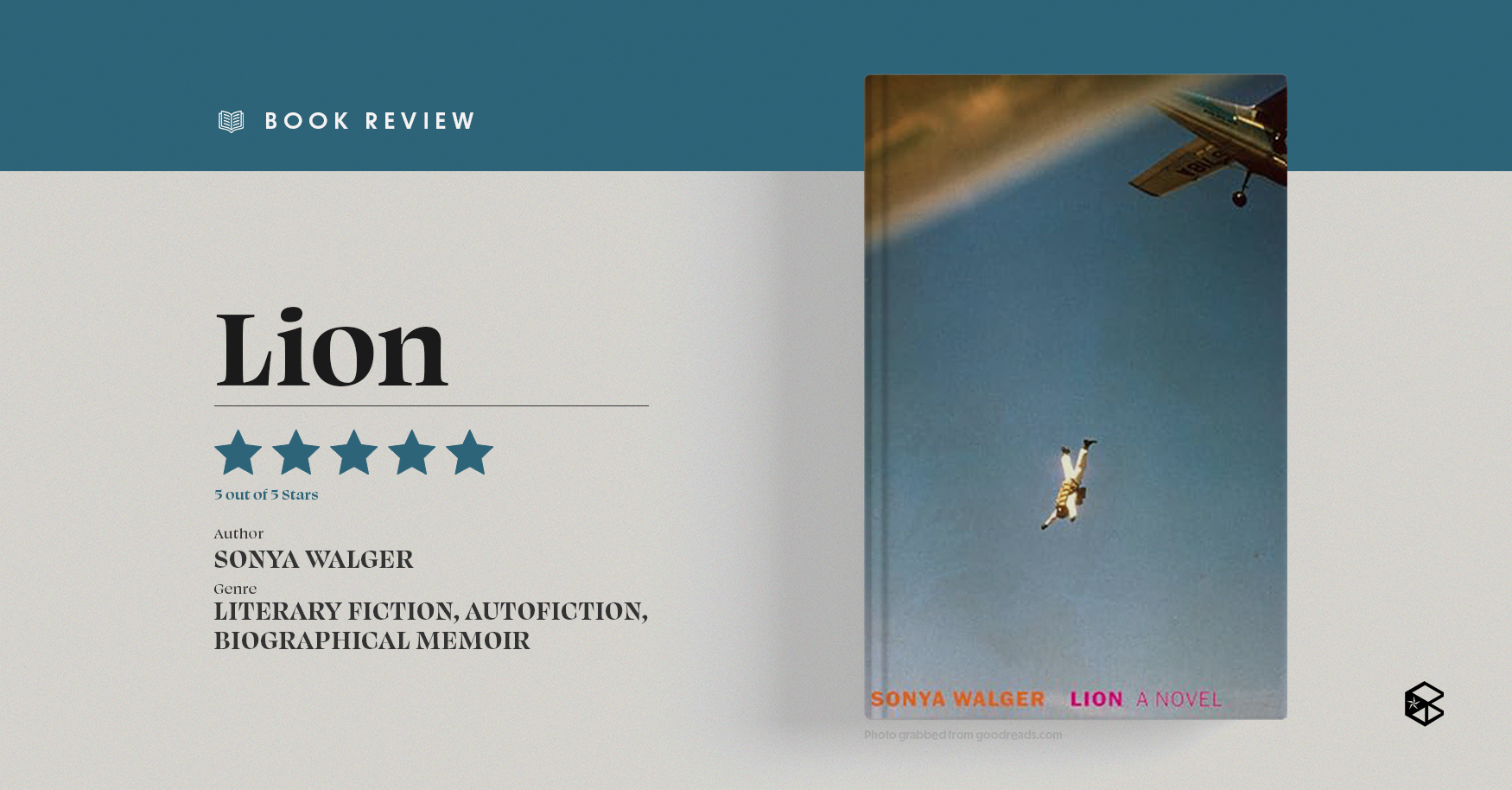




Title: Lion
Author: Sonya Walger
Genre: Literary Fiction, Autofiction, and Biographical Memoir
Rating: 5/5
“Lion,” written by Sonya Walger, is a raw story that explores the volatile presence—and mostly absence—of a father through the eyes of his daughter.
He is many things: a con-man, an addict, a skydiver, a race-car driver, and a world traveler. Yet never all at the same time, as he slips in and out of the aspects of his multifaceted identity—like his fatherhood—too often.
The voice between past and present
Walger's writing is blunt and direct, but never at the expense of lyricism and metaphor. Her retrospective yet tender prose reads like a grown woman trying to make sense of her younger self's experiences. It is reassuring, but it also acknowledges the reality that not everything can be fully understood from the distance of memory and time, and especially not through the rose-tinted perspective of a child looking up to an absent father.
This is the very uncertainty that shapes much of Lion. The memoir isn’t only about an absent father figure, but also about the impossibility of constructing a reliable narrative from unreliable memories, especially when each one seems to recount a different version of the man at its center. However, rather than attempting to resolve these contradictions, Walger learns to embrace them. She revisits childhood experiences and family anecdotes to reveal how identity is shaped not only by what happens, but by the stories we choose to tell ourselves after them. By the end of the book, we are less concerned about whether she can fully make sense of her father and, more concerned with how his image in her memory will shape the family and relationships she has built for herself.
Everywhere and nowhere
Our narrator's childhood is defined by her father's repeated disappearances and reappearances. With each return, he seems to reveal a different man: sometimes more stable, more present, or more capable of being the father she wishes he could be. Yet these reunions are always short-lived before the cycle inevitably begins again.
This makes her father seem to exist in a constant state of motion. He is between countries, relationships, careers, and identities, always chasing the next big adventure and always being just out of his daughter's reach. This motion—the refusal to remain in one place or one version of himself—is ironically what creates a sense of stillness. This is seen in his growth as a person. All his physical and emotional restlessness returns him to the same negative patterns of behavior, preventing him from growing beyond his immature pursuits.
His behavioral pattern becomes a trap for the narrator as well. Each return, disappearance, and partial reappearance of her father only loops her understanding of him back into itself. There seems to be an endless number of things he would rather be doing, and an equal number of excuses she has made for him. And like her, readers get caught between frustration and affection, unable to completely reject a man whose charisma remains as compelling as his failures. Each time, one hopes things will be different. But by the final page, he is farther away than he has ever been.
In the end, Lion accepts that some people can never be fully understood, and asks what it means to keep loving them despite it all.
Lion by Sonya Walger is available in print and ebook formats through Amazon, and as an audiobook narrated by the author herself on Audible.
