




Drithi was born in the ghost of Batuhan.
A wide grid of single-storey buildings, old dreams of gold and timber turned to dust and rust—a widescale paving and enclosing so that everyone could feel the warmth of the New Sun and be under the microscope of the Almighty. Zoning laws made it so forward and up that it became one panoptical dome of blinding light over Batuhan. Anything that dreamt of scraping the sky eroded the soil under and around itself, coaxing a sea level that was already slowly washing the city under.
The New Sun was a tall tower, a lighthouse with a lantern so bright that the shaft up to its cupola vanished in its own brightness, its own shadow uncasted. No one knew what the Almighty looked like, only that He was there and that He was always looking.
Residential laws made it so everyone lived in bungalows. Walls and fences were erected as the people’s small way of contesting their own privacy. They prevented most from seeing eye-to-eye, save for stolen glances where shame and scrutiny were negotiated. This culture cultivated an unkind people who always averted their eyes and, in turn, felt entitled to look down on those who were, in the literal sense, smaller—children.
Drithi, the smallest child of Batuhan, had a way of looking that was unknown to people after the New Sun. She was born with queer proportions that made it clear she was going to have a small stature her whole life. As she grew older, her parents concluded that her condition was not merely physical, but that it also reinforced a mental one. Literally and figuratively, she was closer to the ground, her spirituality influenced by a whirring sound, almost magnetic, that only she could feel underneath her big, little feet.
Drithi was curious, persistent, and defiant. This particularly was what set her apart—her insouciance to meet eyes. Because of how people ostracized her, her defiance became an endless unraveling of excess and intention.
She had grown captivated by a forbidden site in the city, said to be a crack of unfathomable depth in the Earth that formed when the sun died. Legend says, although Batuhan prohibits tall tales, that when the crack formed, so much of the city died, and only petrified phantoms remained, singing forlorn songs, wishing for the Almighty’s overdue promise of safety.
But Mishti once told Drithi that she heard them singing hymns of freedom and comfort, not suffering and regret. Dark-skinned, stout Mishti was the young caretaker of Drithi's mother’s father and her closest confidant. She was said, although the city denies their present existence, to have come from a lineage of Batuhan’s native ancestry—animistic, worshippers of fruit and rocky terrain, singers, and oral historians. In the midnight, Drithi’s father sent Mishti away for good, when Drithi woke up in the half-dark to the sound of Mishti’s lullaby converging under the whirring sound of the Earth. First, there were letters, and then there were none.
So one day, Drithi began her descent, and everyone saw her, but no one stopped her. She was about to become Batuhan’s greatest lesson, proof that the minuscule have a penchant for mutiny.
The crack was vast and deep enough to be a canyon, and it intersected with the southern faraway end of the dome’s wall. Her heart and mind were continents diverging, and Drithi could no longer look back. Only onwards and down the vacant eye in the land. No walls. No fences.
She harbored the love she wished to see in her years—knee-buckling, jack-knife, shouting, demanding, consuming. She moved with it. Nowadays, love is so quiet, she thought. It used to be the whole world.
The light softened in the canyon’s crust and was gradually swallowed in its depths. Drithi often thought of herself as light to embody it—knowing which direction to take, reflect, refract, and be absorbed. It faded like a song, holding the hand of the dark, becoming it. She climbed down like this, using the juts and recesses of the Earth as steps.
When there are no visual or ritualistic indicators for time of day, one step is a second, and a descent is a whole lifetime. Drithi persisted in honoring the exponential dark, although she swore her pupils dilated to the size of her scleras just to take whatever the New Sun left in its wake. And then motion itself was surrendered by the same defiance that brought her here, that same passion born alongside her and had to wear every day.
Between the canyon walls, a space of suspension extended from her body. She did not feel her own weight, her own warmth, nor the temperature of what surrounded her. Only the unrelenting song, the one that Mishti used to sing to her. And the whirring that made her body melt into everything.
Through the threshold of numbness, Drithi looked down, and she could see again. Only, below her looked to be the same opening, the same crack of light, from which she descended a lifetime ago. And above her—the darkness to which she was going, the darkness that remained unconvinced. But there was something growing against the pulse of her small body. A staff where Drithi could see the notes of her memory.
The beach: the sound of waves like the sun slow-cooking skin. The sea was respected by Batuhan because of its judgment, because in it the people were baptized and drowned. But Drithi always saw it for the way it danced with light and dark, pointing it in different directions so that it could touch the seabed faster. The sea was not a judge but a caretaker.
Crescendo. Drithi was closer. A fervor overtook her, a rush to bite the finish line and rip it herself, to find out if she would be standing right where she started, or if everyone was right and she walked herself right into hell. She thought if hell had real fire, then she would take its hand into her own. She was ready to burn.
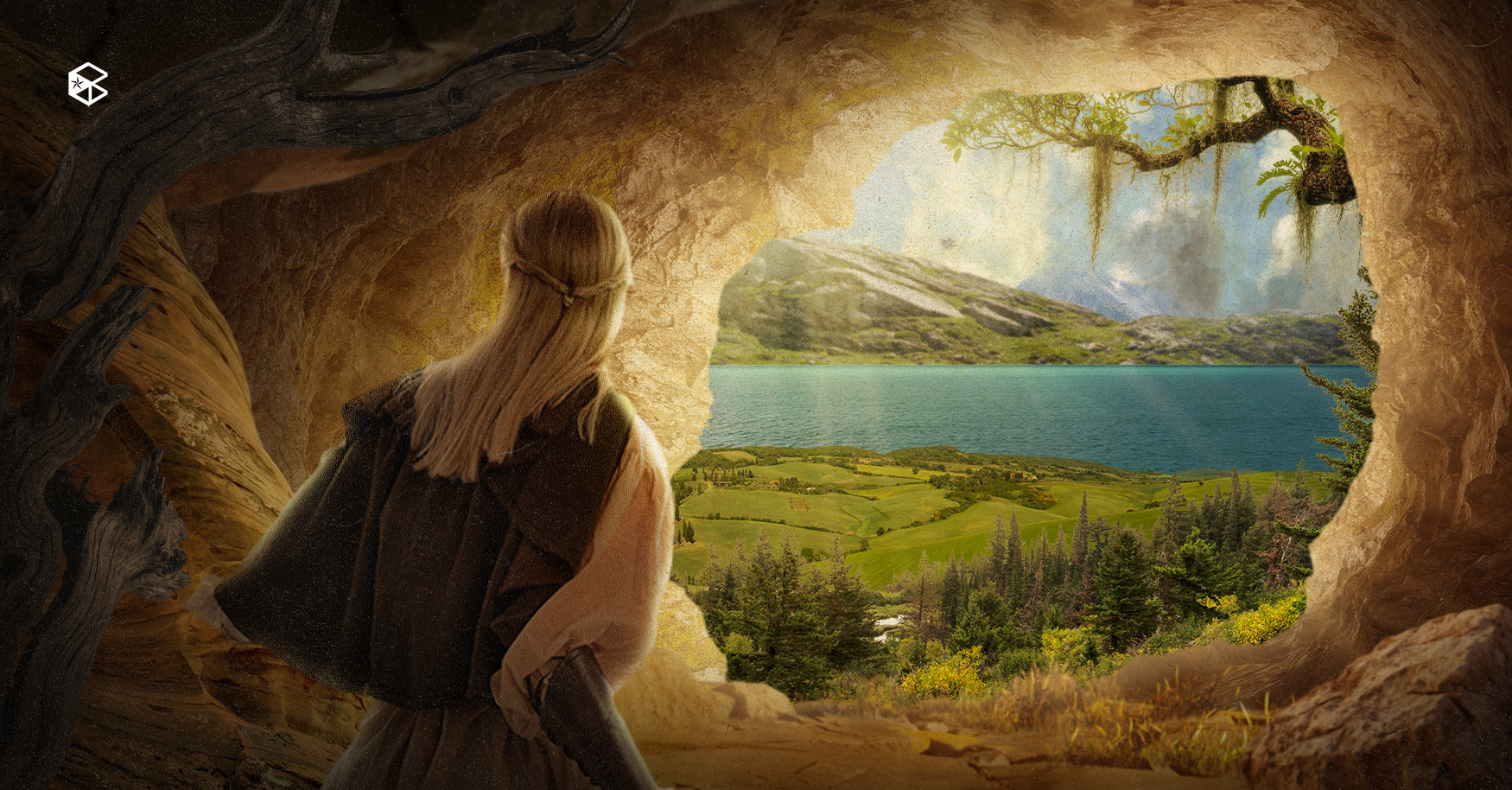
A vast, feathery blue light quietly bled where the walls of the Earth split. She dipped her foot into the clearing, and then suddenly, the crack swallowed her into a mirrored gravity, spat her out, and then she fell and found herself lying down on the corner of a primordial mouth. She had climbed into the Earth and out the other side.
And there was no dome, no walls, no fences, no tower. No hellfire, no song. Just a sky that curtained a soft sunrise and a sea that skirted the shoreline. The sun ahead of her was small, like a baby star, shining with an innocence to its radiance, an impassivity at the child confronting it. She could smell herself in the premature heat, the pockets of air between her hair strands that trapped hot sweat and breath. But the morning lapped at her regardless, granting her a warmth she somehow remembered.
The scene had a gaze where all timelines collapsed into a singular thrum and broke out into a chorus of centennial trees extending across the land behind her, whose breath held her nape, rich rock, soil, and sand with slumbering gold, and a sun that did not vanish in its own brightness.
Drithi was reborn on the mirrorside of Batuhan’s ghost—its soul. She was light. She knew which direction to take, when to reflect, when to refract, when to be absorbed. And this was toward Mishti, to hear her song one more time, and to fade into and become one with it.
