
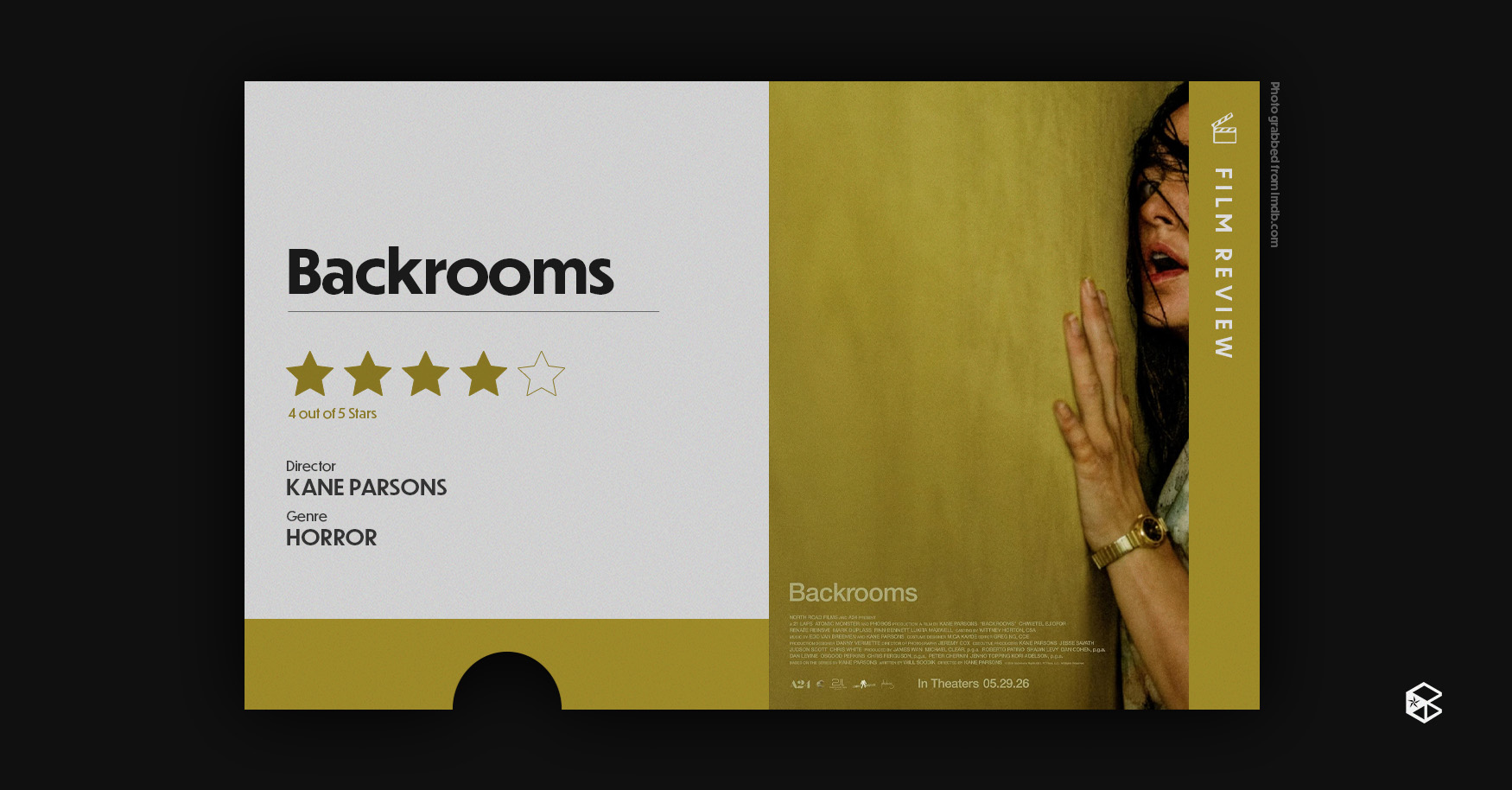




One of the most awaited films of A24—directed by 20-year-old Kane Parsons—traces its origins back to a single wandering photo in 4chan. Released on June 3, Backrooms brings the internet-born phenomenon to the big screen, where a digital myth transforms into a full-scale horror experience. What began as a digital anomaly has now evolved into a new era of horror defined by liminal spaces and entirely new types of entities.
Set in the 90s, the film follows Clark (Chiwetel Ejiofor), a failed architect struggling to sell furniture. His behavior reveals his deteriorating mental state, which eventually introduces his therapist, Dr. Mary Kane (Renate Reinsve). The tension began as Clark noticed a series of anomalies occurring within the basement of his workplace.
Behind the wallpaper
Before becoming a theatrical experience, the Backrooms existed as an unconventional, open-ended internet myth. Originating from a single wandering image posted on a platform called 4chan, the concept grew through a collective imagination as opposed to a fixed story. While Kane Parsons’ YouTube series provides important context for the film, the feature’s ability to leave questions unanswered was what truly captures the essence.
In an interview, Parsons expressed his desire to meet the original author, also noting that the concept’s strength lies in its lack of a singular direction. It is an open-source creative project where multiple, simultaneous versions can coexist. Unlike traditional horror franchises bound by established timelines, the Backrooms served as a collaborative space where anyone could contribute interpretations of their own.
Backrooms’ appeal lies in this creative freedom. Whether audiences engage with expanded lore, Parsons’ specific version, or various gaming adaptations, these variations led to one thing: exploring the unknown as the familiar turns strange.
Art of the unknown
The visual identity of the Backrooms is one of its strongest elements. Instead of complex designs, Parsons uses simplicity as the foundation of horror. The space is ordinary: empty, office-like interiors, repetitive hallways, and unfinished rooms. Through repetition and atmosphere, what was once familiar now becomes unsettling.
The found footage style strengthens this effect. Rather than observing from a distance, the camera creates the illusion of physically entering the Backrooms. Imperfect movements, distorted perspective, and raw visual quality make it feel like a discovered memory against a framed film world. Along with the sickly yellow tone that dominates the whole environment, its color carries psychological associations of caution, decay, and uneasiness.
Even with his large-scale projects, Parsons keeps everything under tight control. He uses Blender to map out his environments before filming starts, which let his team visualize the sets and plan their shots in the digital space. Through his use of light pools and calculated framing, he turns a simple setting into something psychologically overwhelming.
Mind within the space
The film’s strongest idea lies in its transformation of space into psychology. Backrooms behaves like a reactive environment shaped by the fragmentation of the human memory it absorbs; it is not a fixed dimension. Rather than constructing spaces with logic, it recreates them imperfectly, like memory itself. The result is a world that mirrors the mind: structured, yet deeply unreliable. The entities followed this same logic, manifesting as distorted echoes of things once known but never fully understood. They remain just off enough to be deeply, unsettingly wrong.
Clark is a man defined by order. As an architect, he constructs systems meant to impose clarity on the world. Yet Backrooms strips that away, leaving him in an environment that refuses logic. He even tried to rationalize space by comparing its infinite sprawl to the utilitarian definition of furniture: a desperate attempt to categorize the uncategorizable.
What is more unsettling than his confusion is his adaptation. The film captures the suffocating comfort of being “stuck.” When feeling like a failure, staying within that version of oneself can feel safer than attempting change. Clark recognizes the horror of this situation, yet feels powerless to escape. His arc is further darkened by growing selfishness, as he begins treating his co-workers as expendable prey in order to remain hidden.
One of the chilling moments of the film is how Clark responds to the situation around him when the story reaches its third act. His unexpected action further defines his character, and reinforces how well the film portrays his worsening mental state. At this moment, he had adapted the ecosystem of the Backrooms and realized his actions had consequences.
Reflections of memory and fear
If Clark represents entrapment in the present, Mary represents entrapment in the past. As a therapist, she speaks the language of memory, helping others process what they cannot understand. Yet, the film reveals that she is not separated from the patterns she studies. Her journey is a parallel descent into unresolved history, where she confronts the meaning she has avoided. Both characters are drawn by the need to understand what cannot be controlled.
The relationship between them was strained by their roles: an unqualified therapist paired with a difficult patient. This imbalance underscores how unstable their positions of authority truly are, blurring the line between the one seeking help and the one meant to provide it.
The entities serve as mirrors rather than traditional antagonists. They respond to the characters; they tailor their behavior to match the internal state of their prey instead of simply hunting. During chase sequences, their speed and aggression align with the character’s own panic. This shifts the horror from being pursued by something unknown to the terror of confronting a hauntingly familiar version of oneself.
You have reached the end
Backrooms ended without resolution, leaving behind a lingering uncertainty that mirrors the characters’ own experiences. It is a film built on incompleteness, where meaning remains slightly out of reach. Its strongest moments came from what it withheld, allowing the audience to piece together intention through fragments rather than explanation. Even without the knowledge of its internet origins, it captures the essence of the Backrooms mythos: the terror of encountering something familiar that never fully resolves.
Its non-linear storytelling suits an environment meant to disorient and unsettle. Beyond liminal spaces, the film explores behavior, mental health, and how internal states shape the environments people inhabit. From the 4chan image to the YouTube series and now cinemas, the story continues to evolve.
Despite its strong conceptual foundation, Backrooms might not resonate the same way for every viewer. Its meaning relies on symbolism and psychological suggestion rather than a direct explanation, creating an intentionally abstract experience. This allows for interpretation, though its ideas on memory and identity may feel less immediately clear to some viewers.
Just like what Clark says in the movie, “It’s like trying to describe a dog to someone who’s never seen one before, and then asking them to draw it”—the result is never entirely wrong, but never entirely right either.
Backrooms goes beyond being trapped in a place. The real horror lies in the realization that the place was built from a person all along; their memories, their fears, and everything they were never able to leave behind.
The film becomes a more immersive experience on the big screen. It feels less like watching and more like entering the world, with its anxiety, eeriness, and emptiness amplified in a shared theater space. The visual effects, alongside the performances of the actors, carried the film’s surreal atmosphere and successfully brought the impossible world of the Backrooms into reality.
Now screening in cinemas nationwide.
