
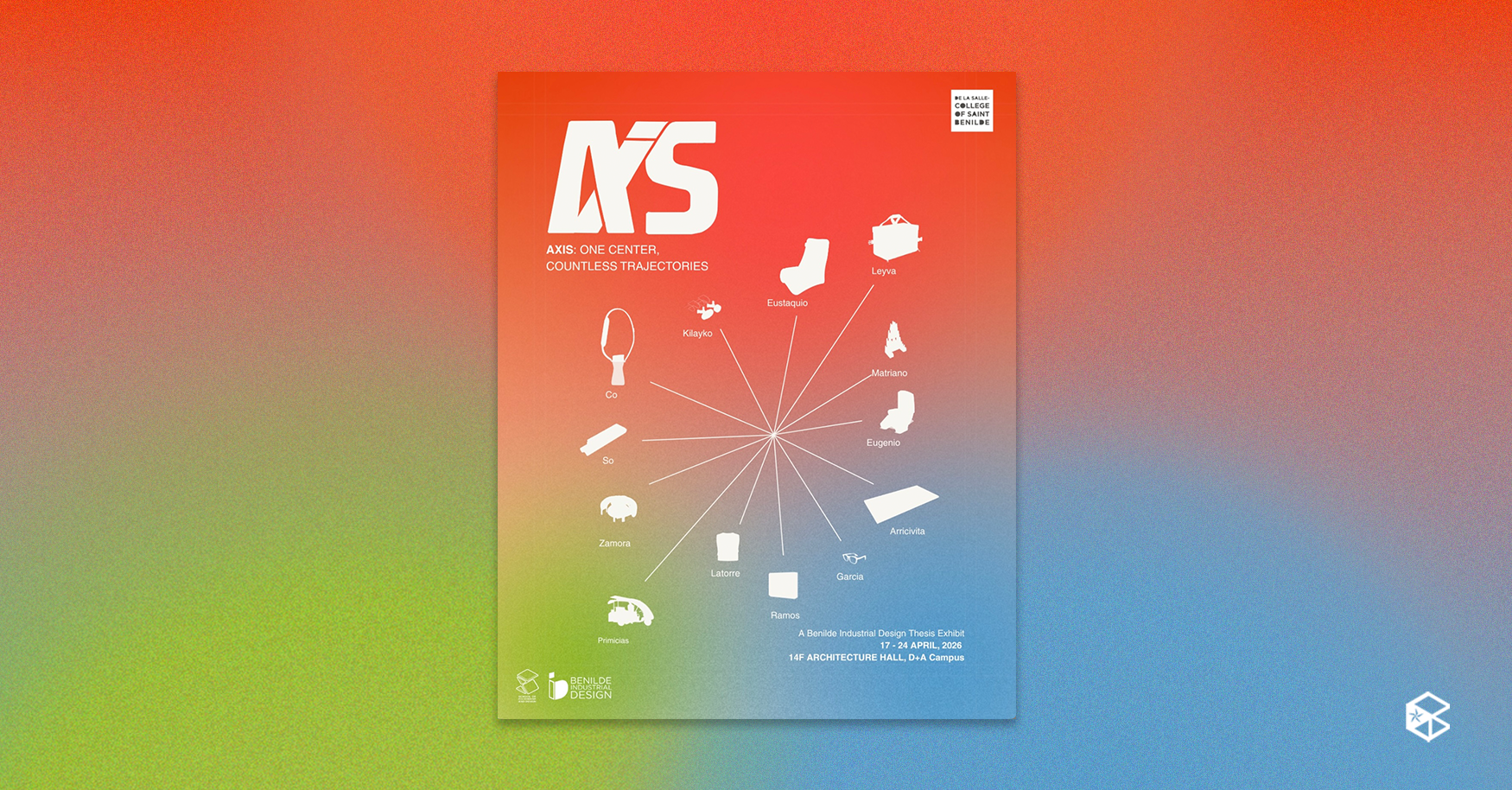




DLS-CSB’s Industrial Design (BS-ID) program held “AXIS: One Center, Countless Trajectories,” a thesis exhibit from 13 graduating designers at the Architecture Hall, 14/F Design and Arts (D+A) Campus from April 17 to 24. Among the designs were a diverse range of innovations, including educational and interactive designs, safety and mobility designs, health and assistive designs, and sustainable and environmental systems.
Mr. Andrei Dumaguet, an Industrial Design faculty member and thesis adviser, officially commenced the exhibit with opening remarks, inspiring the graduating batch to continue moving forward as their venture in industrial design is just beginning.
With the guidance and expertise of best thesis jurors, Mr. Romeo Catap Jr., an industrial designer, educator, and creative communications professional, Mr. Noli Araral, a brand designer and community manager at Benilde Hi-Fi, and Mr. Freddy Anzures, a Filipino-American designer specializing in technology, the opening night ended with the awarding of the batch’s top works, including:
Best Thesis - Ali Lorenzo Arricivita (ID121)
Best Thesis - Julianne Tisha Leyva (ID122)
1st Runner Up - Kara Danielle Co (ID121)
2nd Runner Up - Adriel Pauline Ramos (ID122)
3rd Runner Up - Luke Eustaquio (ID122)
From concept to execution
As the Project Head of the exhibit, Leyva shared in an interview with The Benildean the meaning of AXIS and how it came to be.
“It’s inspired by the idea of an axis as an invisible yet essential guide. In our exhibit, we see AXIS as a central anchor that brings all our works together. Each of our projects has its own purpose, process, and outcome, but they are still connected. At the same time, it allows our ideas to expand, rotate, and move in their own directions,” she explained.
Despite the unified theme, the process behind the exhibit was far from linear. With only a limited timeframe after thesis defenses, the designers worked through a fast-paced and often challenging production period. “At times, it really felt chaotic,” Leyva admitted, stating how collaboration, adaptability, and trust became essential in navigating their different work styles. In the end, the experience proved to be a fruitful one which resulted in a well-executed exhibit that showcased their journey and shared vision.
The designers and their trajectories
Each designer approached their thesis with a distinct perspective, rooted in personal experiences and real-world needs.
For Eustaquio, whose design, a Seating to Assist in Emotional Regulation for Counseling Environments falls under the health and assistive design, his thesis was conceived from the idea to serve others. Inspired by his personal encounters with mental health support systems, he explored how design could improve underserved spaces such as school guidance offices.
“Design shouldn’t just revolve around the designer’s perspective,” he shared with The Benildean. “It should always strive to serve something beyond ourselves.”
Similarly, Jadon Kilayko, an ID122 BS-ID student, focused on safety and mobility with his design of a Non-Intrusive Bicycle Signaling and Rear Detection System. Motivated by the increasing number of cycling accidents, including that of a friend, his design acts as an added layer of awareness on the road. To guide in his research process, he leaned into immersive methods such as interviews and firsthand experience, including regular biking. His design ultimately reflects a strong call for safer and more inclusive road systems, he shared with The Benildean.
Arricivita describes his work as human-centered and emotionally driven, with his inclination for funky furniture pieces, toys, and anik-aniks, his design of a Toy Integrated System to Foster Emotional Communication for Children with ASD encapsulates just that. “I’m mostly interested in creating designs that are fun and purposeful,” he shared with The Benildean.
Arricivita drew inspiration from his girlfriend’s cousin, who has Autism Spectrum Disorder (ASD). “Seeing how their family in Canada had access to many resources, tools, and support systems, it made me realize how valuable those are,” he explained. This realization pushed him to reflect on the lack of similar access in the Philippines, leading him to design a system that is both accessible and adaptable.
Meanwhile, Co approached her thesis from her anxieties and worries about earthquakes, especially as her younger sister attends school near a fault line. Her design of a Portable Earthquake-Response Product for Six to Twelve Year-Old Children is rooted in both urgency and concern. “During an interview with Disaster Manager, Sir Martin Aguda, he mentioned that safety starts with a culture of preparedness,” she shared with The Benildean, emphasizing how this idea reinforced her goal of making preparedness more accessible in everyday life.
Guidance and growth through Industrial Design
Across all projects, one common denominator was the role of Benilde’s Industrial Design program in shaping each designer’s approach.
For many, the program served as a foundation to their growing practice, providing technical training and an understanding of design beyond surface-level processes. The student-designers expressed their gratitude to faculty mentors such as Mr. Marlon Barnuevo, Mr. Catap Jr., and Mr. Patrick Sunico, whose guidance and mentorship helped cultivate their design thinking and innovations.
As shared by Arricivita, “The BS-ID program helped in cultivating my creative vision by teaching me to approach design as both a creative and a problem-solving discipline. It encouraged me to look beyond appearances and focus on how design can create meaningful solutions.”
Designing for today’s needs
What makes AXIS particularly compelling is how each project responds to present-day concerns—whether it be mental health, educational, mobility, safety, or environmental concerns. These conceptual pieces address gaps within communities by providing breakthrough solutions.
Through AXIS, Leyva reflected on the deeper meaning behind the exhibit and the journeys that shaped it. “I want to remind people that, just like in design, life doesn’t always follow a straight path. I’ve experienced moments of uncertainty, changing directions, and facing setbacks, but I’ve learned that these different paths are connected to a bigger purpose.”
