
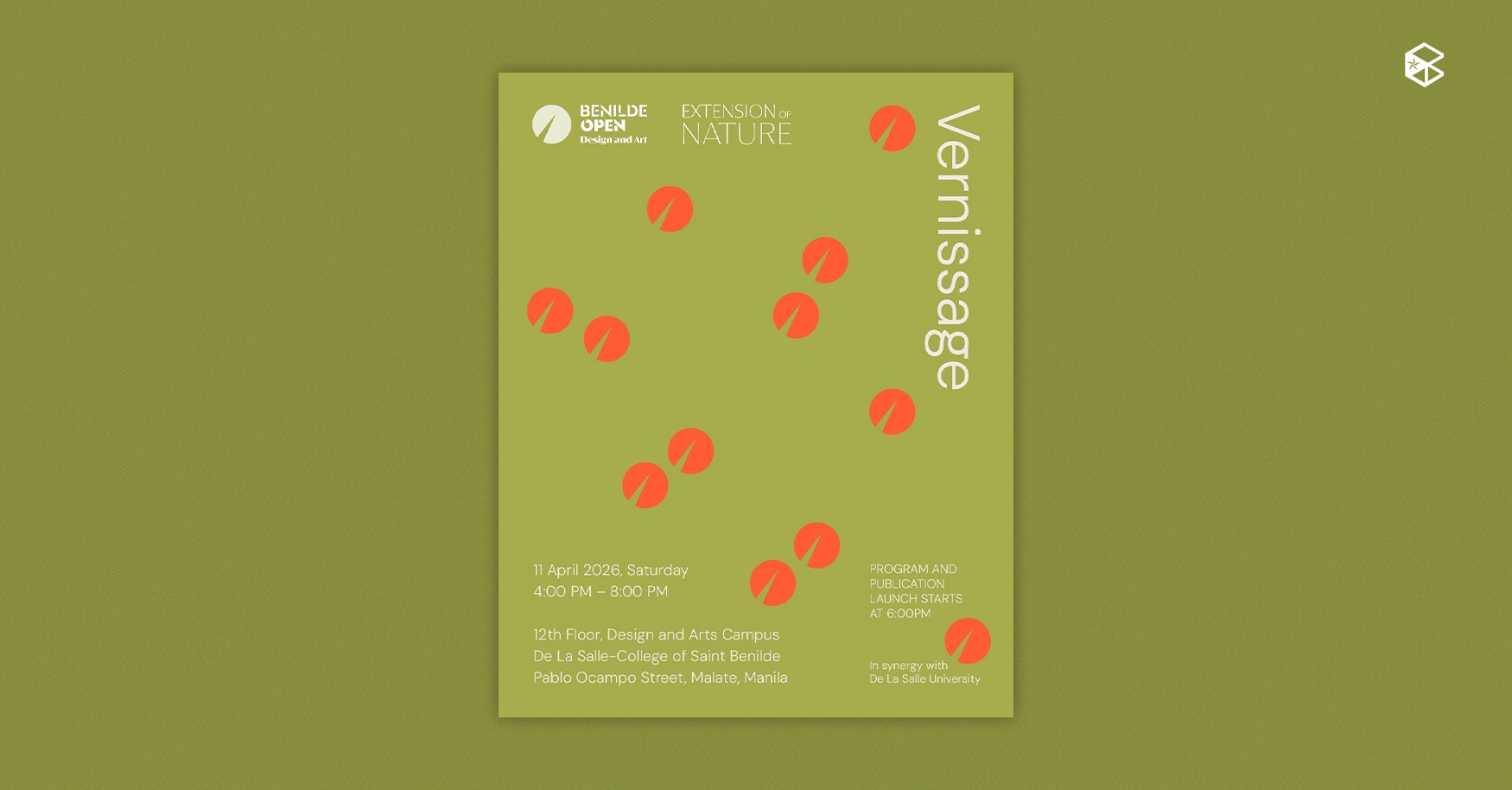




Benilde Open: Design + Art opened its vernissage on April 11 at the 12/F Design and Arts (D+A) Campus of De La Salle-College of Saint Benilde (DLS-CSB), gathering grantees whose works spoke beyond aesthetics. Running until April 27 under the theme "Extension of Nature," each piece on display was an imaginative response to the intersections of creativity and the environment.
Now on its second edition and in synergy with De La Salle University (DLSU), the Benilde Open: Design + Art is a grant-giving initiative that supports unrealized projects by creative practitioners both within and beyond the Benilde community. This year, from hundreds of proposals submitted by artists, 10 grantees were selected for production grants of up to ₱300,000 each, alongside Best of Benilde grantees who received ₱50,000 grants.
The pre-opening viewing was accompanied by the launch of a publication, Curious, showcasing the inaugural 2024 Benilde Open—making the evening as much a beginning as a celebration.
Flash of light
The vernissage opened with remarks from Br. Edmundo Fernandez FSC, visual artist and the current president of De La Salle Lipa, DLS-CSB, La Salle Green Hills (LSGH), and DLSP-NYEL.
"Design and art [are] so foundational in our existence and in the way it shapes our environment,” he said, pointing out that art and design aren’t confined to galleries and museums because it is everywhere—and Benilde Open exists, in part, to make that visible.
"Benilde Open represents something important in the life of our institution," Br. Fernandez closed, further adding that "it reflects our desire towards strengthening creative research, and it mirrors our drive to ensure there will always be a healthy dialogue on matters pertaining to art and design."
Convener Mr. Ayi Magpayo took the podium next, tracing the exhibit back to its unlikely origins, a casual conversation over drinks with Br. Fernandez a few years prior. "To be honest, it's quite surreal," he admitted, reflecting on how a simple question—what can Benilde do to make a mark in the design and art ecology of the Philippines—grew into something larger than life.
"We realized it morphed into something more," he shared. "It aspires to be a thought leader, an institution that delivers innovative ideas and insight that shapes the way we think."
He noted that what Benilde Open had become was a platform to test the untested, to realize the unrealized, and to be daring in its support of creatives. A sentiment he heard echoed back from grantees and proponents alike was "The Benilde Open is one of a kind. It's not only a pat on the back, but truly generative."
Seeds planted
Representing the selection committee, juror Dr. Timothy Moore offered a view from outside the country. "The fact that De La Salle-[College of Saint] Benilde makes this prize happen is quite unique globally," he said. "You should be really proud of what's happening here."
Speaking on behalf of the jury, he shared that what struck them most about this year's submissions was the extraordinary breadth of practice across the Philippines. "Together, these works don't simply solve problems," he noted. "They are asking the really tough and hard questions that we need to ask today."
The jury, he explained, looked for three things in each project: originality, quality of realization, and demonstrated capability. "You have shown courage," he told the grantees, "and your work reflects not only your individual and collective talent, but also the strength of a wider cultural equality in this country."
The evening closed its opening program with remarks from Mr. David Bayot of the DLSU Publishing House, who marked the launch of the Benilde Open publication with warmth and wit. "With the publication of this volume together with the indelible influence of the College," he reflected, "the endeavor of Benilde Open is now already an open book that no one and nobody can shut down."
A stained glass window
The works were as varied as the realities they responded to. Kiri Dalena and Ben Brix trained their lens on Negros Island with Common Ground, a video installation that sits with the island's ecological volatility and layered history. Karl Castro's Locus Pocus took a different approach—a kinetic social infrastructure built around collective care and the simple, urgent act of water interaction.
On the other hand, Bianca Carague turned the Filipino tradition of kamayan inside out with Technospoonism, a collection of wearable jewelry that doubles as cutlery, reimagining how Filipinos eat through a futuristic, kinetic lens. Nicolei Racal posed a question as tender as it was unsettling with What If Snow Falls in the Philippines—an installation that sits with the environmental shifts quietly rewriting the country's future.
Alongside them, the Best of Benilde category spotlighted two student grantees—Patty Malijan and Pen Vinzon—each receiving ₱50,000 to bring their own early-stage ideas into full public view. Such is perhaps the clearest expression of what Benilde Open has always intended, which is to close the gap between a classroom idea and a work the world can actually encounter.
Fresh breeze
Visitor Mr. Victor Javier shared in an interview with The Benildean that he was struck immediately with the atmosphere: awe-inducing, he said, but grounded. "Very global siya in a sense, like pwede siya globally, pero very Filipino pa din ‘yung context niya."
What lingered with him most was Locus Pocus, Castro's kinetic social infrastructure, which he watched visitors sit in, lean on, and fully inhabit. "Ang dami ko nakikita na nakaupo, nag-uusap, or humiga doon sa duyan," he recalled, "and nagustuhan ko lang na pwede pala gamitin ang art na nasa exhibit."
What he left with was simpler and more urgent than any single work: "We have to take care of the environment, dahil sa 'tin nakasalalay ang future natin."
Meanwhile, Ms. Denice Cruz, a self-described regular of art exhibits, was candid about what keeps drawing her back to spaces like this one. "Most of the museums accessible to the majority of Filipinos feature antique art or crafts from people who have passed away, which many often glorify rather than actually supporting local Filipino artists who are still alive," she shared. It is a frustration that makes exhibits like Benilde Open feel necessary—spaces where living, working Filipino creatives get to be seen on their own terms.
What drew her in most that evening was Technospoonism. "Blending Filipino culture with the way we eat with futuristic accessories is very transformative," she said. "It made me realize that we don't have to constantly orientalize ourselves to showcase our culture, we just have to be more imaginative [in] how we do it."
Her broader takeaway from the night carried the same sharpness: "Art obviously can't solve the issue of climate change and the slow death of our environment, but what it can do is disturb the comfortable and comfort the disturbed. Art is a weapon when wielded right."
Stepping into the exhibit is, in a sense, stepping into nature—seen through the eyes of artists who had spent months asking what it means to extend it. That question outlasts the exhibition—it was always meant to.
