
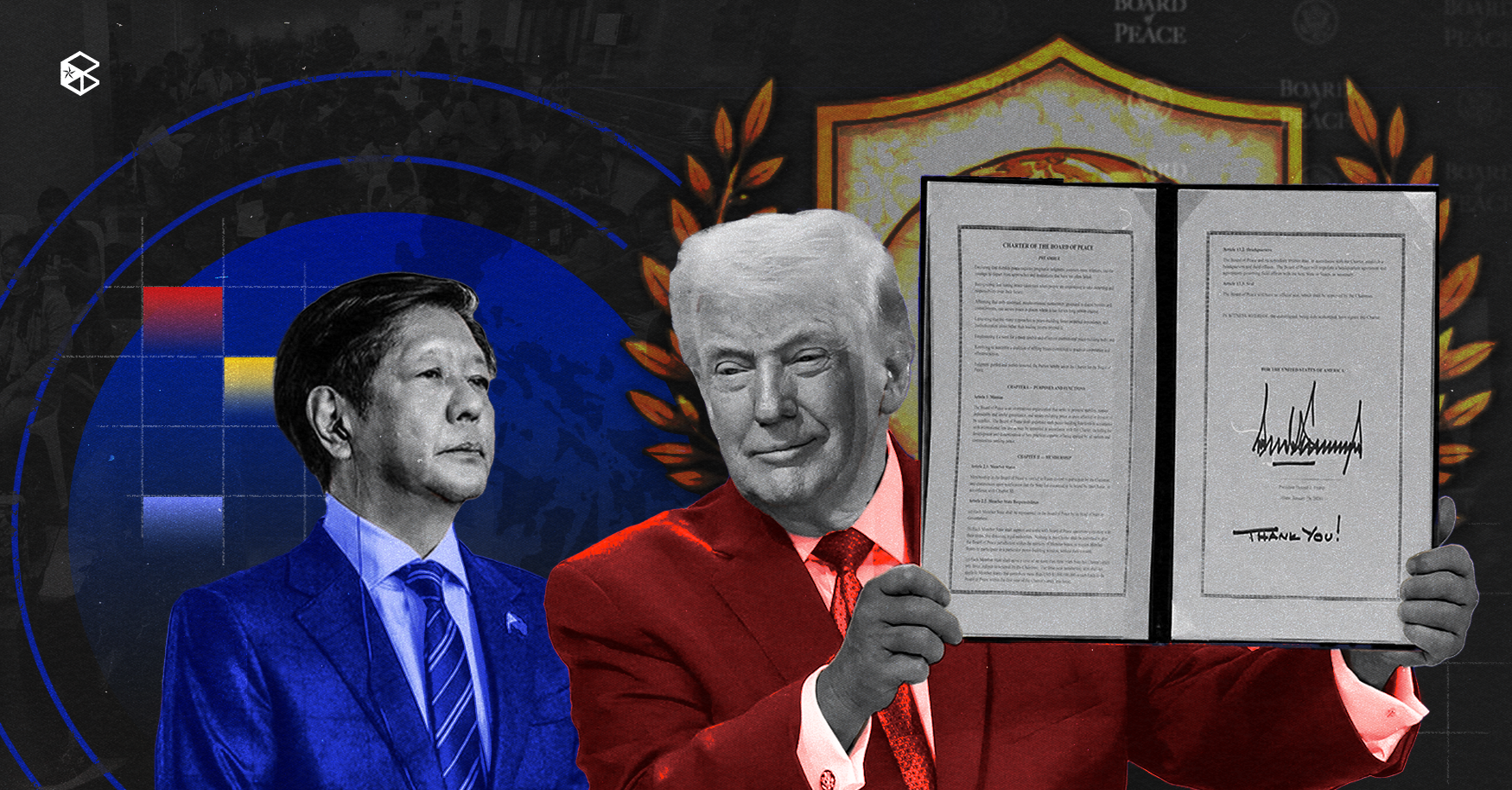




Marking the 80th anniversary of the Philippine-United States (US) relations, Philippine Ambassador to the U.S. Jose Manuel Romualdez confirmed that President Donald Trump has invited President Ferdinand “Bongbong” Marcos Jr. a membership to join the Board of Peace (BoP) on Feb. 5.
Trump’s new world order
Initiated by the U.S. for a 20-point Gaza ceasefire plan through the United Nations Security Council’s (UNSC) Resolution 2803, the Board of Peace was supposed to be a temporary overseeing body for the International Stabilization Force (ISF). However, Trump is now expanding the board into an international organization. Currently, there are 26 member states that accepted, out of the 50 states invited.
The BoP operates in a transactional “pay-to-play” manner, where a country must pay the U.S. $1 billion to secure a three-year permanent seat. The U.S. government justifies the payment, stating that funds will be used for Gaza’s reconstruction.
Additionally, unlike other international organizations with rotating chairmanships, the BoP will be operating with Trump as its “chairman for life.” These eligibility rules for the board have raised concerns from different world leaders and diplomats, saying that it is “susceptible to corruption.”
The creation of the BoP is characterized as a direct response to the immobility of the UNSC with addressing conflicts due to the clashing interests of the five permanent members: U.S., Russia, China, France, and United Kingdom. Even with the initiative for peace, the U.S. has repeatedly used its veto power over matters in the Gaza ceasefire.
By creating a board with a parallel structure and with Trump as sole holder of veto power, he has already built a new world order favoring him. If the UNSC is a courtroom that encourages nations to debate laws, the BoP serves as a boardroom where the chairman has the final say.
In relation to the BoP’s rules for eligibility, Romualdez explained in an interview on the sidelines of the 80th US-PH anniversary that the Philippines is open to whatever contribution it can give to the BoP. “We were invited, perhaps to be part of it. Maybe we can contribute our human resources or something along those lines, but I don’t think at this point in time we can afford to put any kind of amount of money outside.” This, however, raised questions regarding Filipino workers’ safety and sovereignty being utilized as “diplomatic currency.”
The Filipino’s American dream
In the context of human resources, the Philippines has been a long contributor to the U.S. with Filipino nurses as a pillar of its medical workforce. According to the 2025 U.S. Census data, there are approximately 4.4 million Filipino immigrants living in the U.S.
The optimistic dream of Filipinos to live in the U.S. has long been fueled by the glamorized portrayal of American living. However, the recent Trump administration has seen many humanitarian issues, especially with the stricter policy on immigrants. The U.S. administration’s credibility is fragile with the reports of arbitrary Filipino arrests and deportations.
The detention of a Filipino lab technician by the U.S. Immigration and Customs Enforcement (ICE) as an illegal immigrant has caused fear for many Filipino healthcare workers. Similarly, ANC reported 130 seafarers were deported and had their visas revoked for criminal allegations such as links to child pornography and terrorism from ICE. With increasing enforcement actions, lawmakers have been scrutinizing ICE and demanding for answers.
In an interview with The Benildean, School of Diplomacy and Governance (SDG) Faculty Member, Mr. Josue Raphael Cortez, explained the implication of the BoP for Filipino immigrants, “This might be significant given the transactional nature of the U.S. This might be viewed by migrants as a safety net for them so as to ensure that they would not be subjected to deportation that is among the primary concerns for Filipinos currently residing in the U.S.”
With the recent political climate where the Philippines is domestically polarized and the world has a shifting global order, diplomacy and alliances among states are essential tools for national security.
Mr. Cortez shared that the possibility of a BoP membership will not have a significant impact yet on the rising tensions with China given that member states such as Vietnam and Pakistan are allies of Beijing.
Moreover, he noted the importance of this invitation “Given that more Filipinos now trust the U.S., then having an appreciation of this invitation will allow them to better understand how we do our toiling with the U.S. in light of the circumstances we are presently in.”
In a world full of uncertainty, the promise of peace sparks a light of hope. The history of Philippine-U.S. relations is deeply rooted in alliance and has seen an exchange of benefits, but also criticisms of dependency and recent humanitarian issues. The future of the country’s national security lies in Marcos’ hands—to ensure it will be protected and secured, rather than being a dubious lease for a new world order.
