
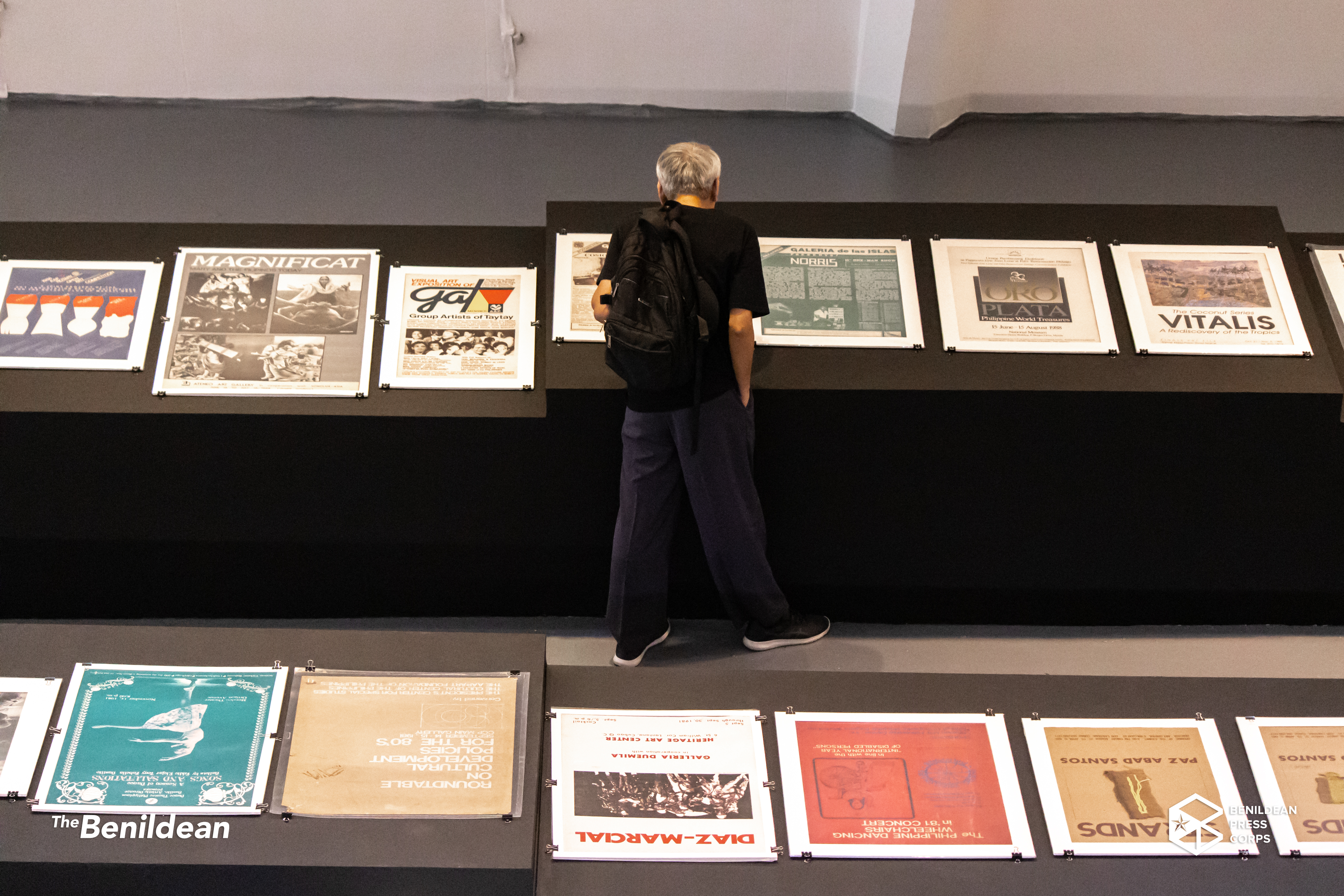




The Kalaw-Ledesma Foundation Inc. (KLFI) and De La Salle-College of Saint Benilde Center for Campus Exhibitions (CCX) opened a curated selection of gallery posters from Purita Kalaw-Ledesma’s (PKL) personal collection, amassed over decades of admiration to the arts. The exhibition was made available to the public from Jan. 31 until March 31 at the 12F and 14F of the Design and Arts (D+A) Campus.
Spanning from 1969 to the early 2000s, Purita Kalaw-Ledesma—a patron of post-war Philippine art, pioneering art critic, and founder of the Art Association of the Philippines—collected posters as memorabilia out of personal resonance, as Mayumi Hirano, PKL Center Director of KLFI shared with The Benildean.
“She was basically within that art scene […] she didn't want it to be forgotten in the future. The way she kept these posters was more like, you know, you go to your grandma's house, there is a pile of things. That's how she really kept these posters.”
Collecting the Moment: Art Exhibitions in Print features a range of posters from the 70’s and 80’s, the period that makes up most of Kalaw-Ledesma’s collection.
Unfolding the archives
The exhibition officially opened with a speech from Ms. Anne Marie Ozaeta, President of the Kalaw-Ledesma Foundation. “As we walk through this space, we can relive the era through form, color, typography, mid-texture [...] These posters remind us of how much work goes [that] there is always a team of creatives, quietly coiling in the background to support the great masterpieces that get hung on gallery and museum walls.”
Unveiling the archives kept by Purita Kalaw-Ledesma for the first time in public, the collection featured posters in collaboration with the foundation and Benilde’s CCX. Mr. Gabby Lichauco, the exhibit’s main designer and a part-time faculty member at DLS-CSB, spoke more about the process, sharing how the exhibition came to fruition. “They gave us 150 posters, spanning from the 1960s ‘till 2000. We realized that most of the posters happened around the 70’s and 80’s [...] So we decided to put [them together]. And that made it much of a stronger narrative.”
Unlike usual exhibits with artworks mounted vertically on a wall, Collecting the Moment’s laid the posters on a desk on the 12th floor, as a nod to the atmosphere of libraries. Designed by Mr. Lichauco, the posters can be viewed from above at the 14th floor.
“You have this balcony, and because of the huge number of works or collections, we decided, why don't we [...] use the architectural structure as part of the exhibition, so when you go upstairs, you see the massive collection of the foundation,” he explained.
Memory curated
Mr. Lichauco delved into the importance of the exhibit beyond displaying the pieces, explaining the significance of history in creating art. “You can't design anything if you don't understand history. So it's always going to be a good reference. What went right, what went wrong. So these are all important points that should be inherent in design.”
Echoing the same sentiments, Ms. Dindin Araneta, Director of Benilde CCX, remarked how the exhibit can contribute to the broader conversation surrounding contemporary arts in the country. “They're archival materials. They talk about a certain time or history when art exhibitions were happening in the 70s and 80s. So they document that. So it's always very important for researchers to know what was happening then. It's good to always have history. And that's where archives serve a significant purpose.”
When asked about how the exhibit’s relation to the Art Fair Philippine’s 2026 program aids in achieving National Art’s Month goals, Ms. Araneta shared that “It's interesting to show it because it is also happening at the same time as two art fairs. It's a good counterpoint to show what was happening in the 1970s as a way of chasing the development of art galleries, [especially] the history and development of art galleries in this country.”
Overall, the exhibition seeks to encourage the appreciation of analog media in this digital world. Mr. Lichauco laments the slow death of print, “I think if you stop printing it changes things. If you're just looking at things through your phone. It's very different. There's actually no soul in it.”
“But now we can see the promotion of Art Fair Philippines is more digitalized. But when we look at the past, all this information about exhibitions was on paper. So we can also imagine this gap in between contemporary and the past. And I think it's important to also remind us there is this texture and physicality of information,” Ms. Hirano added, further recognizing the worth of physical media.
Seeing history up close
Among the attendees was Ms. Andra Alcazar, a Benilde alumna and lover of Philippine art history, who was drawn to the exhibit as a way to support her peers and kickstart the Art Fair festivities. “I think it's my first time also understanding or seeing a format like this in my experience with exhibition design and management.” She shared how the unconventional viewing style along with seeing familiar names like Anita Magsaysay and Fernando Amorsolo, made for an overall transformative experience, seeking Benildeans to appreciate Filipino art history more and to go visit the exhibition when they get the chance to.
In showcasing these archival treasures beside contemporary art fairs, the exhibition becomes a bridge across time—connecting the analog soul of the old era to today’s digitalscape. Each poster, carefully preserved by Purita Kalaw-Ledesma, shows that physical and the personal still matter, that texture and intentionality will always have a place in our understanding of the arts.
The moments have been collected; now, it is up to us to ensure that they continue to resonate. Visit CCX’s on Facebook, and Instagram, and explore memory lane with the Purita Kalaw-Ledesma foundation on Facebook, Instagram, and their official website.
