
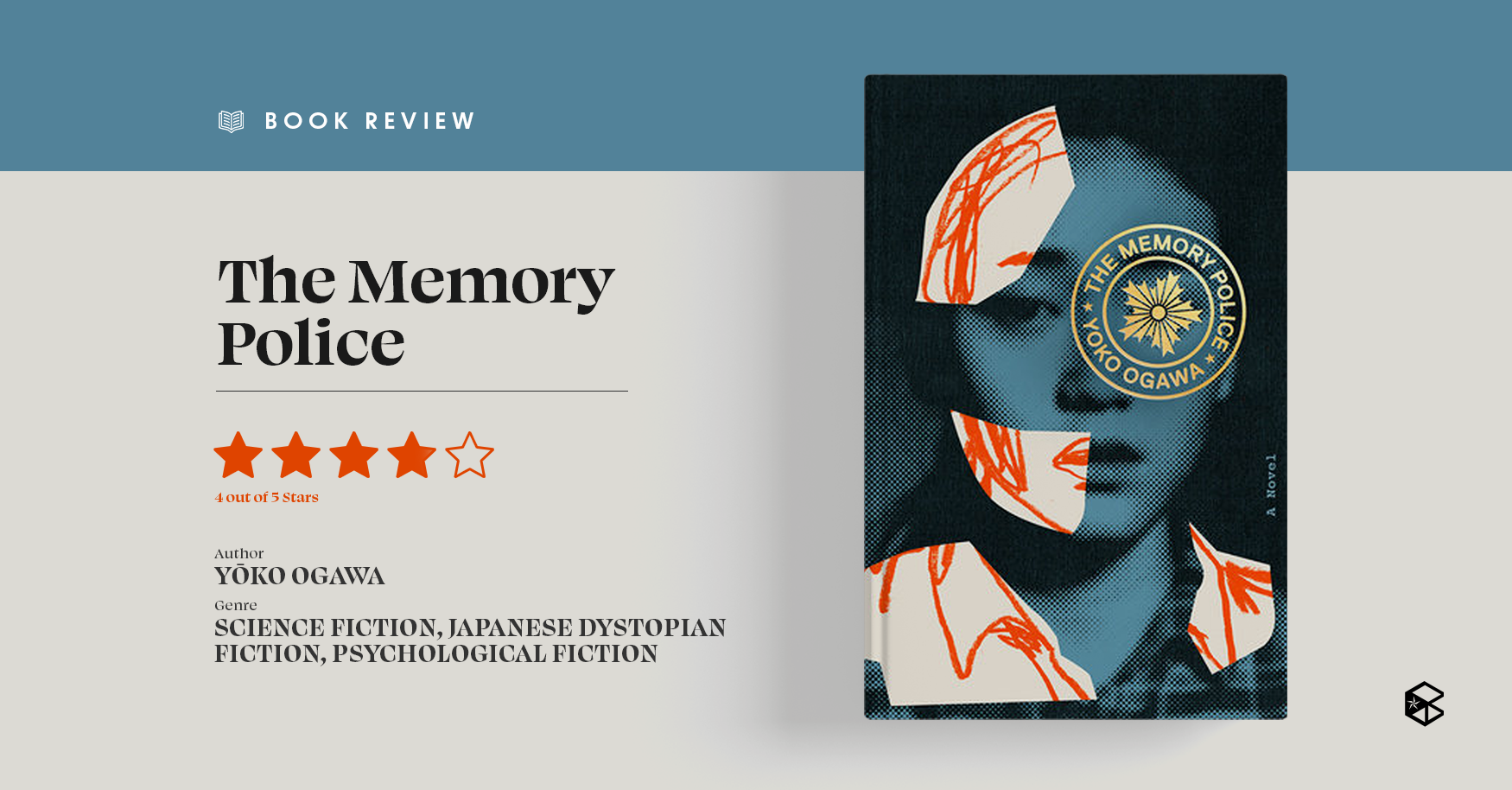




“The Memory Police” by Yōko Ogawa throttles into the familiarity of a dystopian novel—a corrupt, totalitarian system waiting to collapse under a protagonist's hands. You await that moment of catharsis, when the system is finally taken down. But when relief should arrive, Ogawa offers nothing. No uprising, no spectacle, no lone hero defying impossible odds.
The story follows a young novelist and her editor, R, in their struggle to preserve memory on an unnamed island. A strange phenomenon haunts its inhabitants. Objects vanish mysteriously overnight, along with any trace of their existence, even from the minds of its inhabitants. The few who retain their memory pose an even greater threat to the omnipresent Memory Police. An agency that enforces the terrible consequences of the anomaly.
What it means to remember
There is a moment in the book when perfume disappears. Bottles are emptied and discarded. Soon after, the characters no longer recognize or remember the concept of fragrance. As humans, we have always feared forgetting, even without the looming threat of disappearing memories. We hoard photographs, keep empty boxes, cling to items we have outgrown, and associate memories with scents.
And watching the characters helplessly stripped away of all these signifiers of remembrance is what makes the novel so disturbingly compelling. It shows how deeply memory shapes identity and how terrifying it is to lose all connections to the past. So if you’ve ever paused at a familiar scent or object and felt the rush of recollection—this novel will make you ponder on what it means to forget, and more importantly, what it means to remember.
R, the man who remembered
As written in the novel, “And even if a memory disappears completely, the heart retains something. A slight tremor or pain, some bit of joy, a tear.” Throughout the novel, no names, whether of the island or of any of the people, are mentioned. This intention hammers down a perspective of memory that is not tied to labels or facts, but to how things make one feel.
One of the main protagonists, R, does not forget the disappeared objects, unlike everyone else. So, in a world where everything is destined to be forgotten, the fact that he remembers is a small rebellion. Because as long as he remembers, it means that nothing is truly forgotten.
It’s a message that mirrors the real world, reinforcing just how powerful our memories are. Their existence can be erased from a person's mind, but Ogawa reminds us that the essence of what they mean to them–the love, the pains, the longings–cannot be.
Beyond memorization is memory
By the end of the novel, Ogawa’s philosophy mirrors itself in the reading experience. Names fade, and over time parts of the story begin to blur. Yet by the act of recalling the novel, a haze of emotion always resurfaces. Whether it’s a sense of dread for the impossible circumstances our characters are in, or a subtle hope that nothing is truly lost as long as it’s remembered. It’s the lingering nature of whatever sensation you felt that is perhaps exactly how the author intends us to remember The Memory Police.
So maybe it’s okay to throw that empty box away, or to clear out some storage space from your gallery. Memories endure. Maybe not exact dates or details, but the feelings they carry; the warmth, the emotions, they stay with you long after the object itself is gone.
Yoko Ogawa’s “The Memory Police” is available in-store at Fully Booked and online through Lazada, Shopee, and Fully Booked Online.
