
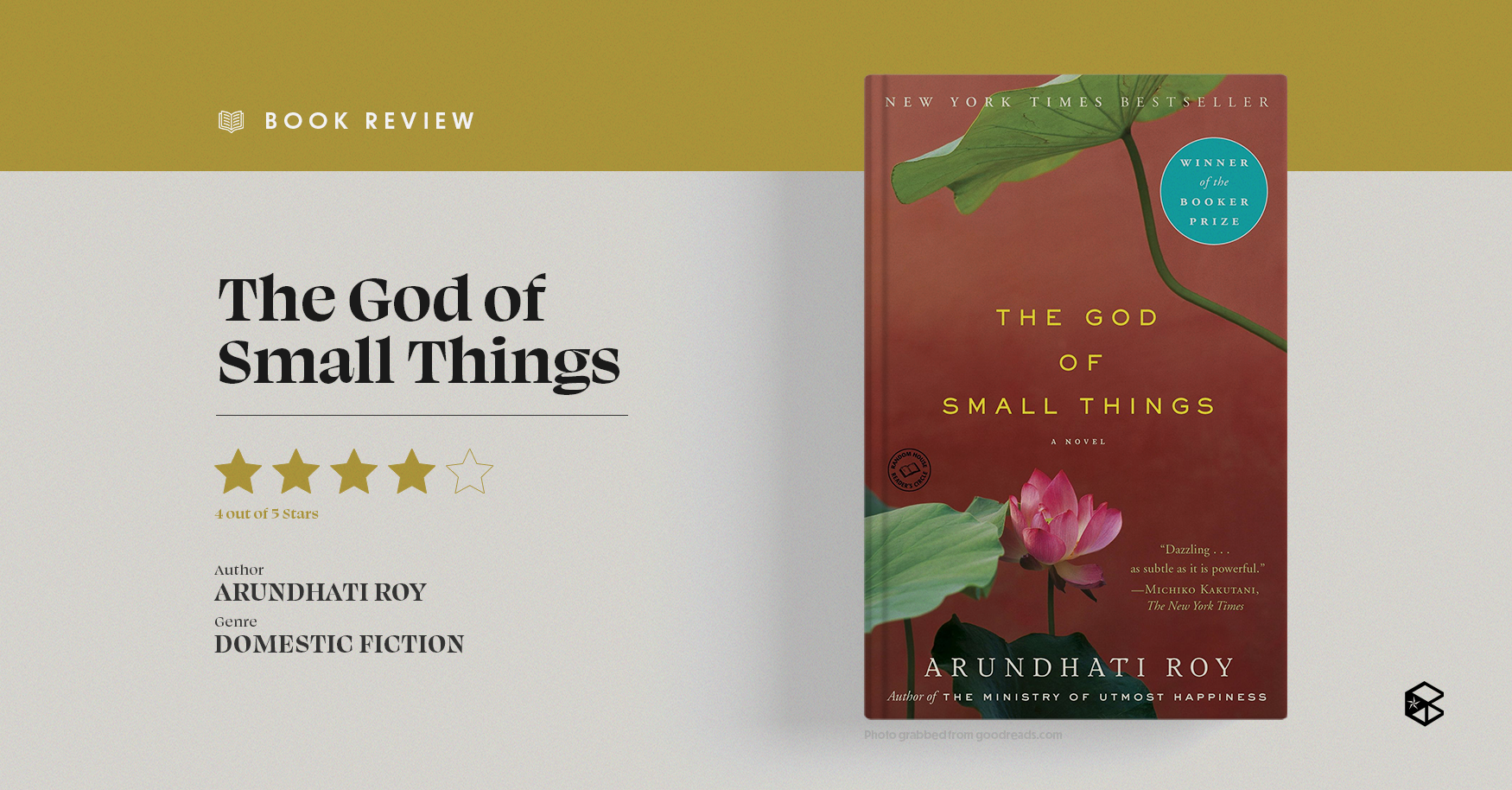




Suspended in the haze of post-British colonialism and casteism in India, Arundhati Roy’s semi-autobiographical novel unearths domestic tensions that reflect the state of a space and memory, forever unraveling.
Author and activist Arundhati Roy’s “The God of Small Things” won the 1997 Booker Prize for Fiction to much global acclaim, and controversy from the United Kingdom. Deeply inspired by personal experiences, Roy constructs a palpable world suspended between then and now—an attestation that the personal is political, and the political is personal.
A turbid river
The novel is about the lives of fraternal twins Rahel and Estha surrounding a traumatic incident that haunts the whole family’s relationships. The Terror—a pivotal drowning. The twins’ slice-of-life tale begins in Ayemenem, Kerala, where they experience a childhood characterized by a distinct political backdrop dictating their family’s histories, decisions, and relationships. Harboring a profoundly emotional twin telepathy, the siblings find themselves negotiating their identities and places in time through turbid recollections of this childhood.
The Love Laws
“It actually began thousands of years ago. Long before the Marxists came. Before the British took Malabar…. Before Christianity arrived in a boat and seeped into Kerala like tea from a teabag. That it really began in the days when the Love Laws were made. The laws that lay down who should be loved, and how. And how much.”
It is evident in this passage alone that Roy’s poetic tone asks questions satirizing the foundations of society. Who is clean enough to be touched? Who speaks English with an undetectable (British) accent? Who gets to pursue a foreign education? Who can’t be tarnished by divorce? Who is pleasant enough to be accepted? Who must only be themselves to be loved?
Roy casts a wide net over familial characters residing in regions brimming with complex imagery and depicts the unnameable experience of postcolonialism in Indian society. Through lingering casteism and the colonial prestige of being able to migrate and speak English, Roy tells a story of a people repressed and controlled, yet compelled anyway to defy the Love Laws.
Bonds transcend the gap between “Untouchable” and “Touchable” and even brother and sister through an inexpressible tryst—one that attests to defiance as an excess of oppressive systems.
Small and big themes
When Rahel returns to their hometown of Ayemenem, behind her a foreign education and tumultuous divorce, “The Terror” is gradually confronted as she reunites with her now non-verbal twin. For the most part, the pivotal happening is only hinted at through flashes—water, a child’s watch, a “sicksweet” smell, death. Again, Roy designs this traumatic event as fluidly as possible so as to not pin down the characters’ behaviors to one definite thing, but to map out a bigger system of control.
Roy’s fluid writing, full of clouds of thoughts, is deliberate. By design, the structure of the whole novel is influenced by her background in architecture—motifs are rhythmic; words and phrases are treated as building blocks, broken down or stacked in unconventional ways to convey the emotion that makes the text a postcolonial staple.
A beautifully dismal nation space is contested—it is written almost as if there is no distinction between people and the region they occupy, as if all part of one unfolding consciousness. This is most apparent in the descriptions of the family’s pickle factory, their home, the river, the neighbor’s house across-turned hotel, the disparities between timelines.
“The God of Small Things” is a landmark of text that lives and breathes, a novel for readers drawn to history and identity converging into a monumental space that is eternally changing.
“The God of Small Things” can be purchased online on Lazada.
