
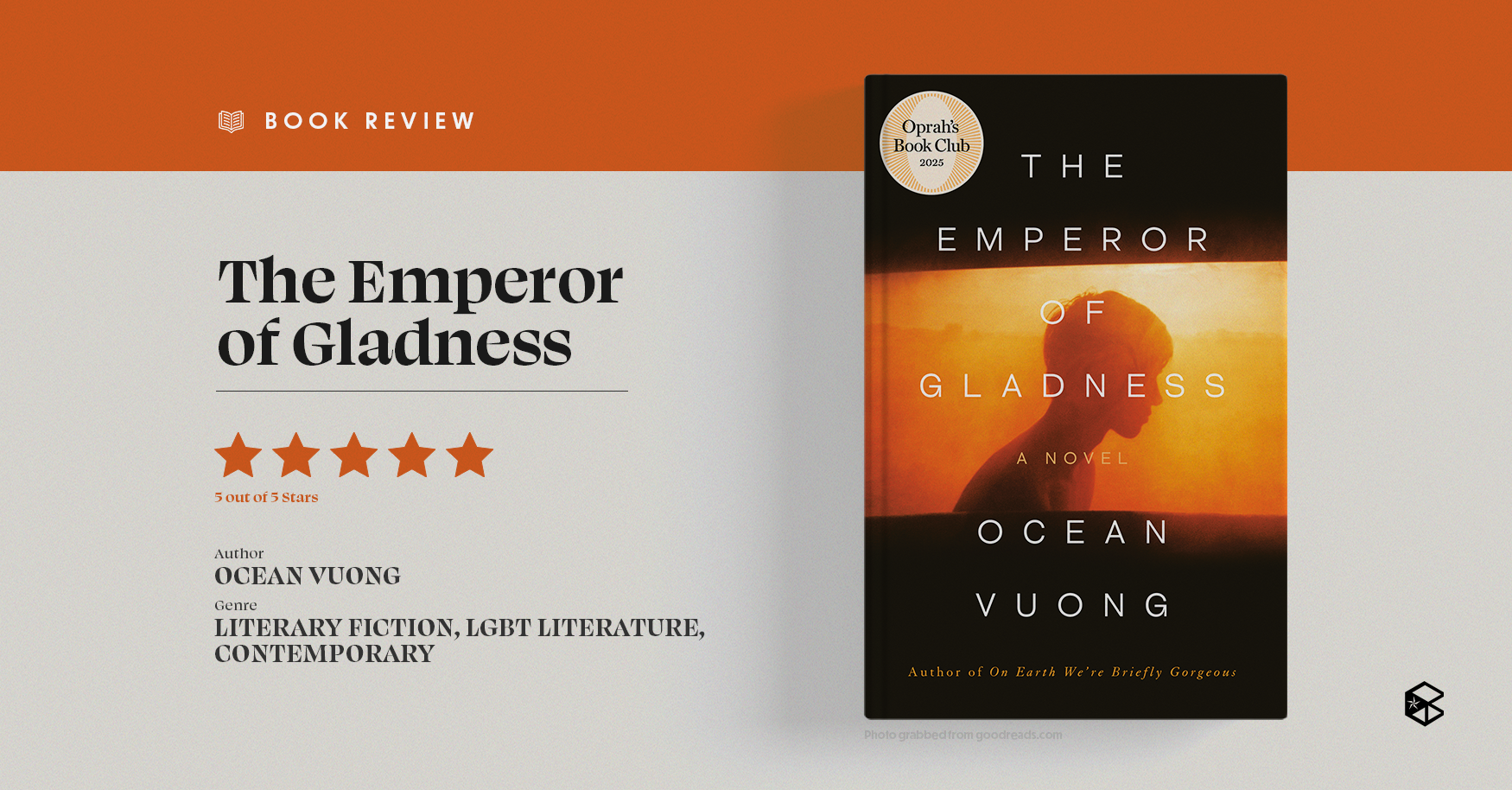




The novel is a story of a boy wanting to rid himself of the hometown dust clinging to his clothes, setting out like a spark flung from his mother’s cigarette. It follows the main character as he lingers in tobacco fields, ramshackle barns, a restaurant’s steel kitchen, a slaughterhouse, rehabilitation facilities, and an octogenarian’s decrepit home framed with old memories that linger like faded tattoos.
The story follows Hai, a 19-year-old queer Vietnamese American who, on the verge of jumping off a bridge, is interrupted by a voice across the river: Grazina, an elderly Lithuanian widow who is slipping into dementia. The growing bond slowly pulls him out of his personal abyss, eventually landing him a job at HomeMarket, a fast-casual food chain located on the outskirts of their small town, East Gladness, Connecticut.
The Emperor of Gladness is a novel about a town but, even more, the lives that pulse within it. It tells of the teenagers who haunt Walmart parking lots, the single mothers hunched over in nail salons, and of the minimum wage fast-food workers serving creamed spinach and cornbread. Vuong offers the readers a story about the magnificence of connections shared between people who are deep in the trenches of addiction, trauma, and grief.
Connection as a form of survival
When do you know the exact moment a stranger becomes a friend? This book encapsulates the uncertainty and mystery of human relationships. Vuong’s characters are written with seething desires, complex facades, and relevant aches to the extent that upon finishing the book, the reader would have the itching urge to call them and ask how they’re doing.
Within the novel, the characters find themselves baring their flaws with the expectant fear of being wrongly perceived, only to be met by warm acceptance. Life would not be what it is without pain. A tight-knit connection, even in the midst of closeted chaos, becomes an escape—one that fills a person with so much gratitude that it reignites in them the passion to be imperfectly human.
The beautiful tragedy of simply being
“To be alive and try to be a decent person, and not turn it into anything big or grand, that’s the hardest thing of all.”
The novel does not shy away from depicting life as it is. Vuong made certain that his characters do not skim through life’s hardships as if on a surfboard, but rather, he drags them through it hard and rough. Then he lifts them for the reader to see and says, “Do you see this? This is the human experience.”
What could be a happily-ever-after ending for other books becomes Vuong’s final exposition. The book ends with a phone call, one answered inside a trash bin—a seemingly ordinary conversation between a mother and her son, framed by make-believe, yet still carrying a sense of acceptance and forgiveness.
Hai, in the end, realizes that his place was never among the hogs in slaughterhouses after all. Instead, it was among a sea of flawed and edged individuals. Together, they walk together hand in hand on the greatest show the Earth has to offer: life.
“The Emperor of Gladness” is sold physically in Fully Booked. It is also available online through Amazon and Fully Booked Online.
