
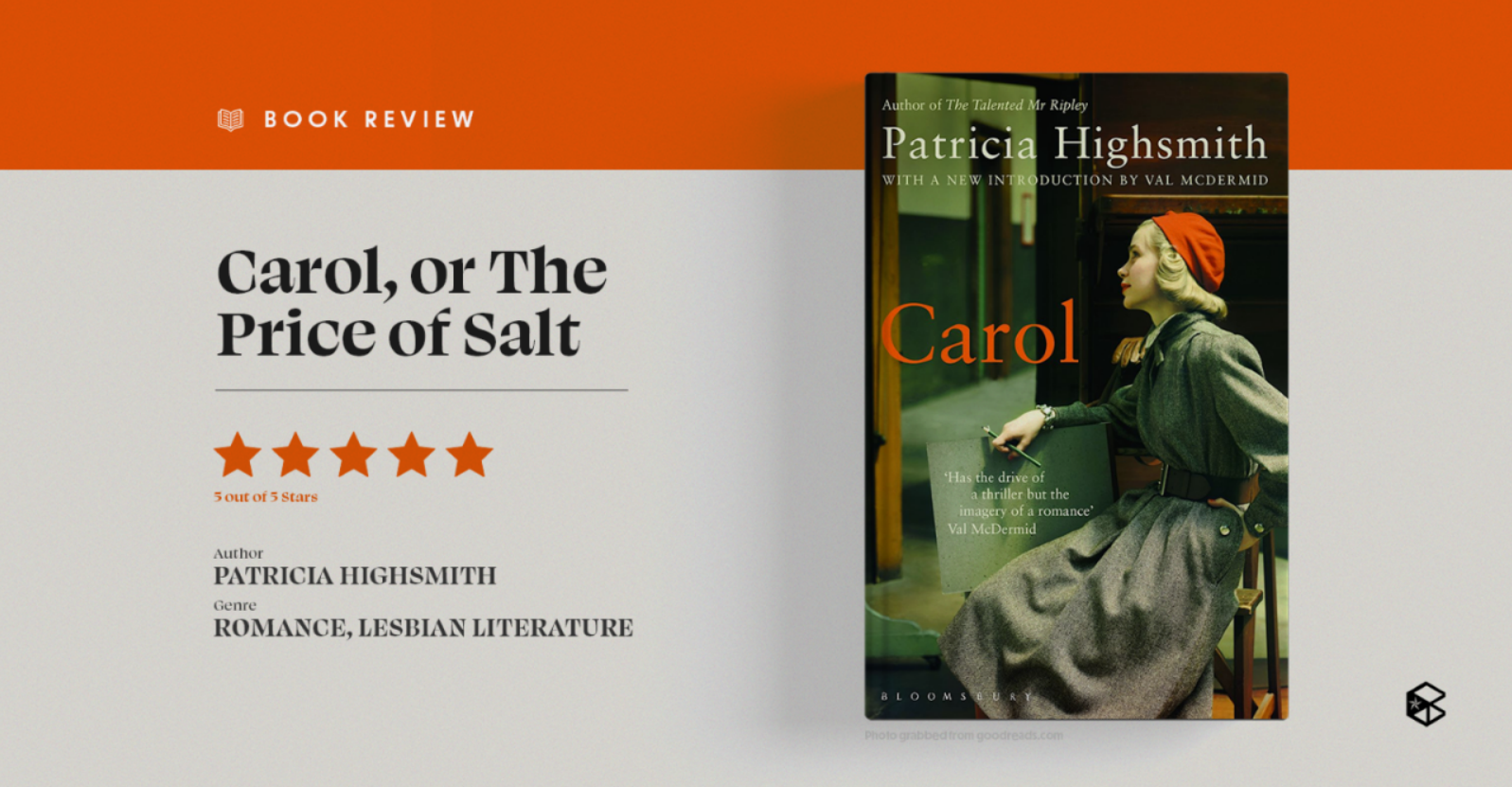




Title: Carol, or The Price of Salt
Author: Patricia Highsmith
Genre: Romance, Lesbian Literature
Rating: 5/5
Under the pseudonym Claire Morgan, in 1952, the “Price of Salt” was released. A haunting romance set in New York in the ‘50s where two women set the tone of their destinies—one where they do not fall into the grain of pressure and still love despite it all.
It was in 1990 that it was reissued as “Carol” under the real name of its author, Patricia Highsmith. This novel is one of the first lesbian stories that gave its main characters a happy fate. It ends with grace, with no succumbing to societal reformations and consequences. In 2015, with its film release starring Cate Blanchett and Rooney Mara, the book entered the public's radar once more.
“Carol” begins with an independent and bored Therese working as a sales assistant in a New York department store. While artistically ambitious, she is generally content to let life pass her by. Particularly with Richard, her boyfriend, toward whom she is indifferent. The brunette feels pressured by him and his family. His words always pertain to their future together and his need for intimacy.
Her lack of interest in this romance turns into an odd relief when she meets Carol. The blonde is older, a socialite in her thirties. Instead of a boyfriend to hide away from, she is married and has a daughter. And soon, Highsmith reveals that even those with high statuses have more to lose.
Hope resides in lingering gazes
There is a certain thrill in not being able to act upon an impulse. And for Therese, that is taking the initiative to fall deeply into Carol’s path. There is a passivity to the brunette. She allows herself to revel in glimpses and only in what the other is willing to give to her. Until she can no longer resist the opportunity to step out of her mundane life. And she pulls herself out from behind the counter and into the older woman’s melodrama.
Every moment of the day that’s not spent with her is filled with boredom and dreariness. She can’t bear to be with her overamorous boyfriend Richard anymore. His constant declarations of love felt suffocating for her. Therese found a sense of fulfillment in bearing witness to the socialite revealing her struggles, her secrets—all confiding. Truly living, she would think, and she was going to do it through Carol.
This can be seen throughout the bouts of their seemingly slow relationship. They meet up to eat, for a drink, or for a road trip that leads to nowhere. But in reality, they unfold their lives in a sad ecstasy. They develop a sense of relief in being able to confide in the other.
Ultimately, they realize that perhaps this cannot be an escape for so long—physically and emotionally. They would need to grow in their own ways, too.
Love above all things—imperfect or perfect
Nothing in Carol and Therese’s world is safe or secure—it felt like the entire novel was sitting on a fault line. It sat patiently waiting for them to be shaken apart at any moment. Their relationship teeters on the edge of falling into something all-consuming. It is this blossoming that refuses to be extinguished. A depth that does not hold back despite the realities of the time within the book and during the author’s era.
From their first meeting, in that description of a ‘shock of love’ just by meeting Carol’s gaze, to the moment the backs of their hands brush—the feeling described as something that burned, something that felt alive. Such descriptors would often spiral into a sense of cheesiness, bordering on delusion. This novel does not do that. There is an aching tenderness that wraps each paragraph. It is evident in domestic scenes like Therese simply admiring how the blonde blots her face with a towel. Something that she never quite felt with her fiancé. It is that belonging that weighs over this book, like a hush before dreams come.
It is rather detailed in an unnervingly reverent and human display of yearning. Adoration that does not sound like infatuation or fantasy—capturing whirlwinds of emotion and sensation with precision. Highsmith had written a story that did not entirely focus on its queer aspect.
The main characters’ sexualities are not sensationalized for shock value. It is written simply as two women orbiting the world—pushing and pulling against the tide of this life set out for them.
It is love without a trace of shame and an ending that promises perpetual sunrises to come.
“Carol, or The Price of Salt” is available online through Lazada and Shopee.
