
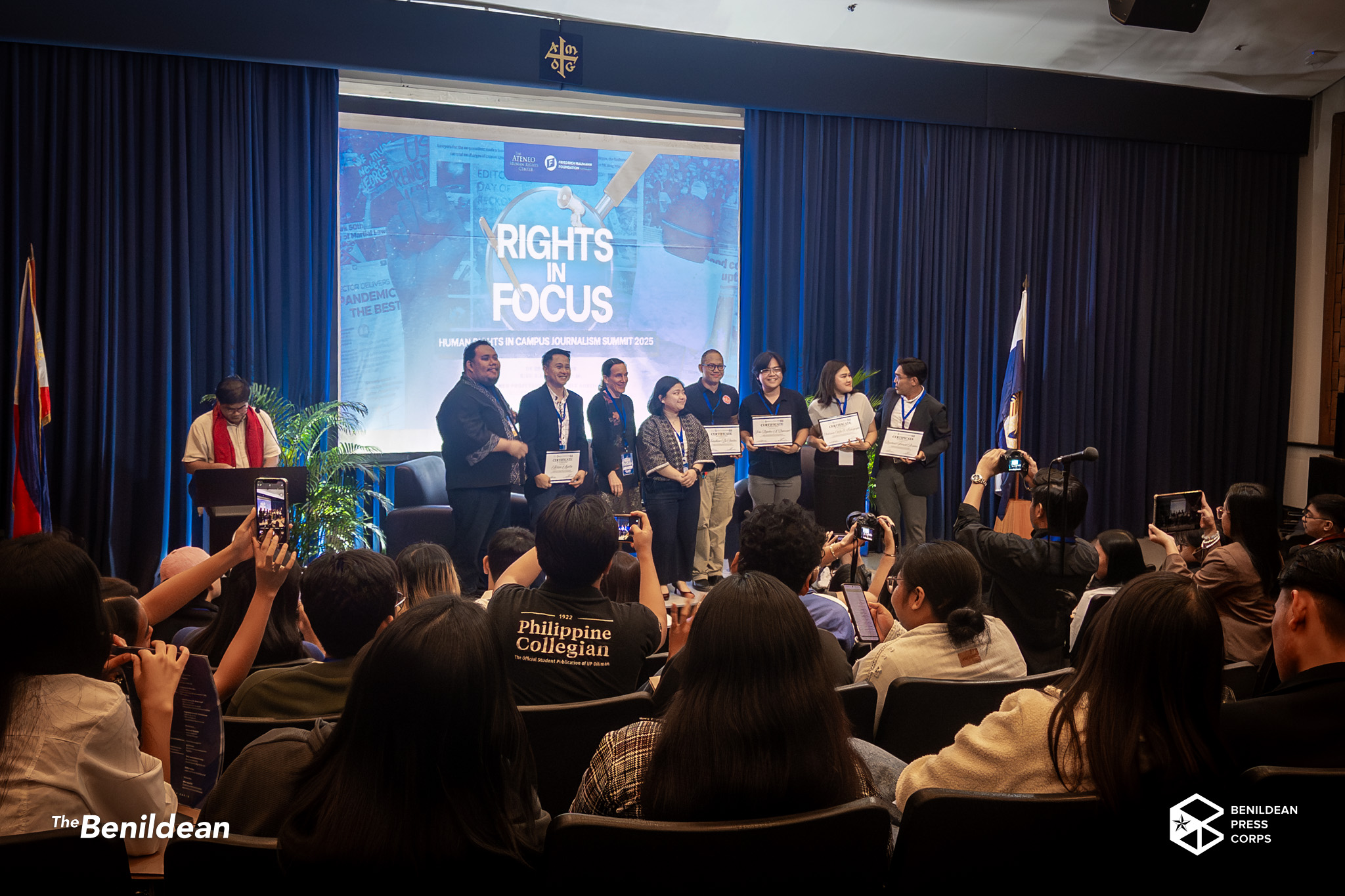




The Ateneo Human Rights Center (AHRC) hosted its Human Rights Summit on Dec. 6 at Ateneo de Manila University, Rockwell Campus, to encourage campus journalists to strengthen their defense of human rights in journalism amidst growing threats to press freedom and civic participation in the Philippines.
The summit opened with a photojournalism exhibit from partner institutions before AHRC Executive Director Atty. Nicolene Arcaina launched the event, stressing the urgency of rights-sensitive reporting amid rising misinformation and harassment. Director Ms. Almut Besold of the Friedrich Naumann Foundation (FNF) encouraged campus journalists to help safeguard democratic institutions responsibly.
AHRC Communications Director Mr. Reyjohn Mark Sangcap outlined the summit’s goal of strengthening accurate human rights reporting, followed by a national situationer from Atty. Katrina Isabela Blanco, the AHRC Internship Director.
The keynote address was delivered by award-winning journalist and 2025 Ten Outstanding Women in Nation Service (TOWNS) awardee, Jamela Alindogan. She urged student journalists to remain watchdogs despite intimidation, setting the tone for the panels and workshops ahead.
The first plenary, moderated by TV Patrol Weekend anchor Adrian Ayalin, centered on the current state and evolving role of campus journalism in the Philippines. The session began with an overview of the campus journalists’ experiences by John Regulus Dipasupil, Editor in Chief of The Philippine Collegian from the University of the Philippines-Diliman, and Chelsea Kate C. Echegoyen, Editor in Chief of The Varsitarian from the University of Santo Tomas. The panel collectively argued that student publications are active participants in national discourse and should be recognized as legitimate journalists, as their risks, responsibilities, and ethical standards mirror those of mainstream media.
Dipasupil noted that the shift from overt censorship to subtler pressures, like funding delays and digital content retraction, reflects the Collegian’s experience and may not apply to other publications.
Echegoyen described the online harassment their staff faces, stating, “So, ginaganun talaga kami sa comment section […] ina-attack na rin personally ‘yung mga writers namin, editors namin.”
Mr. Jonathan De Santos, Chairperson of the National Union of Journalists of the Philippines (NUJP), emphasized that campus journalists face the same dangers as professional reporters but with fewer protections.
He advised, “Kailangan kung kaya nating panindigan ‘yung mga storya, panindigan ninyo.” He noted the NUJP offers "solidarity statements, safety training, and legal support" to combat these real institutional threats.
The plenary concluded with discussions on Artificial Intelligence as Ayalin stressed, “Take advantage of AI, but it’s not the other way around […] we should still stick to basic journalism values.” Echegoyen agreed, stating, “Ginagamit na namin siya for transcription, pero hindi namin siya ginagamit para pagsulatin siya. Kasi, AI can’t humanize your stories. Walang emotion ’yon,” underscoring that AI aids efficiency but cannot replace human empathy in storytelling.
The second plenary explored reporting with a human rights lens. Ms. Lian Buan, senior investigative reporter at Rappler, was driven by personal encounters with vulnerable youth, stating, “I just thought na no teenager should have to go through this, and more teenagers have to know the story of these two teenagers.”
Then, Mr. Raffy Lerma, award-winning photojournalist, traced his commitment to exposure to societal injustices since his student journalism days in the Philippine Collegian. Similarly, Atty. Arcaina rooted her legal advocacy in early exposure to societal issues.
Lerma explained his deliberate use of confronting images to challenge support for violent state policies, saying, “Because you have a society that supports the President and the drug war… I wanted [them] to see that. Ito ‘yung gusto n’yo, ’di ba?”
The plenary then turned to risks, challenges, and threats faced when questioning authority, with Buan describing the psychological and professional pressures of investigative work, including red-tagging and institutional intimidation. Lerma recounted the emotional toll of documenting violence and the isolation of challenging popular narratives. Arcaina added that both journalists and human rights workers often face surveillance, harassment, and legal threats precisely because they confront entrenched power structures and expose systemic abuse.
The program then proceeded with the breakout workshops. Attendees proceeded to breakout sessions, which featured three workshops: “Ethical and Rights-Sensitive Reporting,” “Safety and Digital Security for Campus Journalists,” and “Fact-checking and Combating Disinformation.” Following the sessions, representatives from each workshop reported on key learnings.
Following the testimonies, Ms. Claire Laison, AHRC Children’s Rights Desk Director, led the drafting of the campus journalism human rights agenda, guiding participants through a collaborative Mentimeter activity and encouraging them to define journalism’s role and pursue their advocacy.
Rights in Focus: Human rights primer for campus journalism
A key output of the summit was the launch of the Human Rights Primer for Campus Journalists. It was made in collaboration with major student publications, such as the Benildean Press Corps, The Guidon, The Philippine Collegian, Tinig ng Plaridel, Advocate, The Bedan, The La Sallian, and The Varsitarian.
The Human Rights Primer for Campus Journalists serves as a comprehensive guide to ethical reporting, legal standards, and human rights principles. It trains journalists to protect vulnerable sources, handle sensitive issues responsibly, and identify rights-related concerns in campus and local news, covering topics like the Campus Journalism Act of 1991, freedom of expression, privacy, libel, and defamation.
The necessity of this initiative was underscored by Mr. Sangcap in an interview with The Benildean, who stated, “Journalists are watchdogs of society […] If the watchdog is threatened, how can it do its job?”
He emphasized that this initiative is only the beginning, with plans to expand workshops to nationwide reach, aiming to bring human rights-focused campus journalism outside Metro Manila.
“Our goal is to bring these resources to places where they are needed the most,” Mr. Sangcap said as he ended the interview.
